Vasilyevsky Island Is the Grid, the Spit, and the Quiet Side of Central Saint Petersburg
- Flag
-

- ISO code
- RU
- Currency
- RUB
- Timezone
- Europe/Moscow
On prices: figures on this page were researched in September 2026 and are given as bands, not quotes. Russian admission and transport prices move often. Note also that foreign Visa and Mastercard do not work in Russia: what you actually pay with is cash or a locally issued card.
The Island That Looks Empty When it is Not
Most visitors to Saint Petersburg land on Vasilyevsky Island at the Spit, photograph the Rostral Columns against the sky, and leave. They assume this district is a one-stop postcard stop. It is not. The island is the largest district in the historic centre by area. It is the quietest of the central islands once you walk three blocks inland from the Neva embankments. What looks like emptiness is space. Peter the Great ordered it in 1716, when he told Domenico Trezzini to lay out a grid modelled on Amsterdam. The Soviet-era drop in residential density left more. The result is a district where a 20‑minute walk passes two university buildings, a former customs house, a closed factory gate, a shuttered kiosk. Almost no shops. That is exactly why you should stay here.
What does staying on the island actually feel like once the cruise crowds leave the Spit, and how do the drawbridges shape your night? The answer determines whether you book a hotel on the 4th and 5th Lines or cross to the city centre before 01:00.
Vasilyevsky Island Guide: the Grid You Must Learn
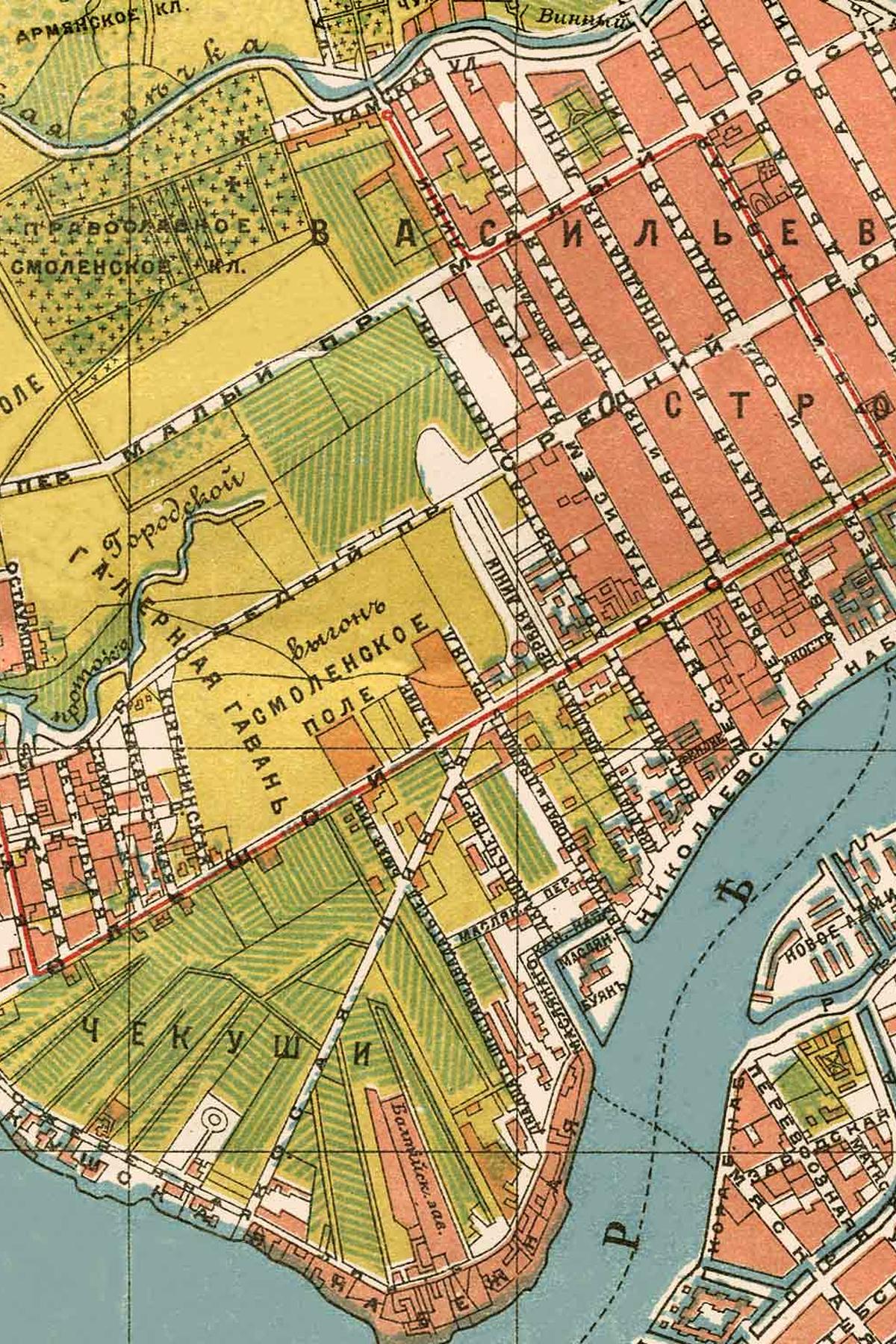
Trezzini’s 1716 plan gave the island three east‑west prospekts, Bolshoy, Sredny and Maly, intersected by numbered north‑south lines. Every physical street carries two numbers: the eastern side is an odd number, the western side the next even number. The 4th and 5th Lines are the same asphalt. The 6th and 7th Lines are one road. There are 29 numbered lines total, and the system works only if you remember that the address “4-ya liniya” means the eastern embankment side of that street, not the street itself. Download 2GIS offline map before you arrive. Google Maps will place you on the wrong side of the line at least once.
Vasileostrovskaya metro station deposits you at the southern end of the grid, near the intersection of Bolshoy Prospekt and the 12th and 13th Lines. From there you walk north into streets that feel residential, student‑focused, and notably less polished than the city centre across the water. The university embankment runs 1.2 km along the Bolshaya Neva, past the Kunstkamera, the Twelve Collegia building, and the Academy of Arts. This is the monumental face of the island. Behind it, the numbered lines are lined with courtyard apartments, student cafés, and the occasional Soviet-era grocery store with a handwritten price list.
Where to Stay on the Island
Book a room on one of the lower-numbered lines between Bolshoy Prospekt and the embankment. The 6th and 7th Lines work. So do the 10th and 11th Lines. These put you within a 10‑minute walk of Vasileostrovskaya metro and a 15‑minute walk of the Spit. Avoid anything north of Sredny Prospekt unless you are on a university visit; the walk to the metro stretches past 20 minutes and the bus frequency drops after 22:00. Budget for cash. Foreign‑issued Visa and Mastercard fail across Russia. The hotel may take a deposit in roubles, and the kiosk selling pirozhki on the corner of the 8th and 9th Lines will not take anything else.
Rostral Columns Saint Petersburg: the Spit at Dusk
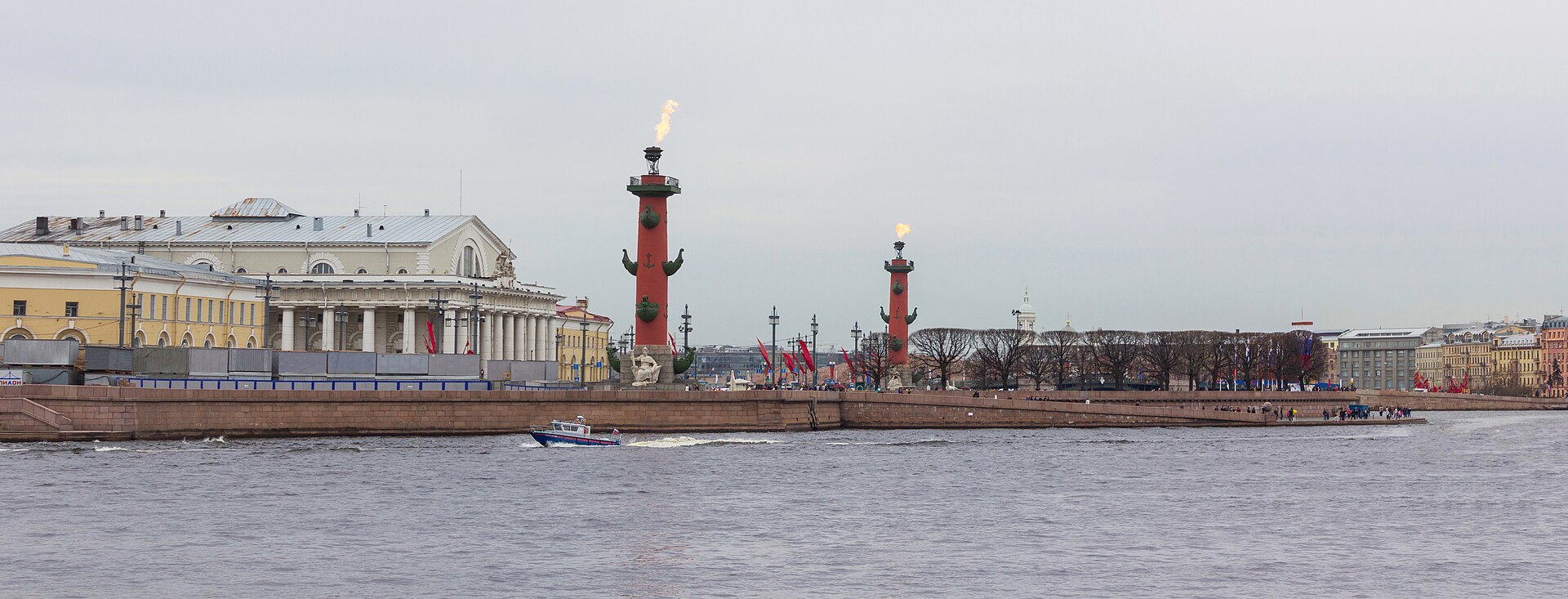
The Spit, where the Bolshaya Neva and the Malaya Neva diverge, is the island’s most photographed point. See it at dusk. The two Rostral Columns, each 32 m tall and built between 1805 and 1810 by Jean-François Thomas de Thomon, were lighthouses guiding ships into the city’s main commercial port. The port moved in the late 19th century. The columns remain, their metal ship prows catching the low light. On major public holidays and during the Scarlet Sails festival, the gas flames at the top of the columns are lit. If you are on the island during those dates, arrive by 22:00 to see the flames against the white night sky. The Old Stock Exchange building beside the columns now houses a State Hermitage Museum branch, the Heraldry Hall and Russian Guard Museum. The real reason to stand on the Spit is the river breeze and the view back toward the Dvortsovy Bridge. At 01:00 that bridge lifts, and the promontory becomes a dead end unless you have checked the drawbridge schedule first.
The Spit Viewpoint and the Drawbridge Trap
The viewpoint at the Spit is free, public, and open 24 hours. It is also the place where travellers get stranded. The four road crossings connecting the island to the rest of the city, Blagoveshchensky, Dvortsovy, Tuchkov and Betancourt, lift on a fixed sequential timetable from approximately 01:00 to 05:00 during the navigation period (roughly April to November). Once they go up, the island is inaccessible by road for several hours. If you are on the city-centre side of the Neva after 00:30 and you have not crossed back, you will need a taxi app for a long detour through the ring road spans that do not lift. The same applies in reverse: if you are on the island and your evening ends at the Mariinsky Theatre across the water, you must be on the island side of a bridge before it opens. The city’s bridge authority publishes the annual schedule. Check it before you book any late‑night tickets. The metro closes between roughly 00:30 and 05:45, so you cannot use it to escape. The practical rule: if your evening involves the city centre, stay there until morning, or budget 1,500-2,500 RUB for a taxi detour that adds 40 minutes.
The Risk of Being Stranded Overnight
This is not theoretical. Saint Petersburg has one of the most restrictive bridge schedules of any European city, and this district is the most affected because it has only four road connections. If you stay in a hotel on the 4th and 5th Lines and your flight lands at Pulkovo Airport at 23:00, you will reach the island just before the bridges lift, or you will wait until 05:00. Plan arrival times around bridge hours the same way you plan them around museum closing days. The island’s quieter streets feel very different at 04:00 with no way across the river.
Kunstkamera: the Strangest Museum on the Island
Founded in 1714 as Peter the Great’s cabinet of curiosities, the Kunstkamera, officially the Peter the Great Museum of Anthropology and Ethnography, occupies a Petrine Baroque building on the university embankment. The collection is anatomical anomalies, ethnographic artefacts, and scientific instruments. The preserved specimens in the first hall have drawn visitors for three centuries. The building itself, constructed between 1718 and 1734, is a 55 m tower visible from the Spit. The museum closes one random weekday per week, usually Monday, and accepts cash only at the ticket desk. Buy your ticket in roubles at the door; card payments may fail. Allow 90 minutes minimum. Skip the upper ethnographic floors unless you have a specialist interest. The strangeness of the ground floor is the reason to come. It is the one museum on the island that delivers exactly what its reputation promises.
New Holland Island: The Contemporary Anchor
Across the Malaya Neva from the southern tip of the district, New Holland Island is a restored brick island with a food hall, contemporary gallery space, and public lawns. It opened in its current form in the 2010s and has become the contemporary counterweight to the 18th‑century heaviness of the Kunstkamera and the Menshikov Palace. Walk there from the southern end via the Tuchkov Bridge, 15 minutes from Primorskaya metro station. The food hall serves Georgian feasting at Khachapuri i Vino and has a beer list that includes Baltika on draft. It is the best place on the island to spend a late afternoon if the Kunstkamera has left you needing daylight and something edible. The Menshikov Palace, built between 1710 and 1727 and now a State Hermitage Museum branch, sits on the university embankment and is worth exactly one hour. The interiors are early 18th‑century, restored, and quiet. Fewer than 50 visitors some weekdays.
What This Area is Bad at
This district is not for travellers who want to step out of their hotel and into a restaurant row or a bar strip. The numbered lines go dark early. After 22:00 on a weekday, the only open businesses are a few student cafés on Bolshoy Prospekt and the late‑night pyshki stand near Vasileostrovskaya metro. The streets are poorly lit compared to Nevsky Prospekt. The population density is lower than the Admiralteysky and Tsentralny districts because large institutional buildings and former industrial zones break up the street frontage. You will walk further to find a grocery store, a pharmacy, or a working ATM that accepts foreign cards. Public toilets are scarce and cost 30-50 RUB; carry coins. The district is also the most vulnerable to bridge isolation: if you stay here, you accept that your evening ends when the bridges lift, unless you pay for the long detour. That trade‑off is the reason the island costs less per night than a hotel in Dvortsovy Okrug.
What It Is Good At
The island is good at quiet. It is good at morning walks along the university embankment when the river breeze is fresh and the cruise ships have not yet docked. It is good for travellers who want to see the centre of Saint Petersburg without sleeping in the middle of it. The Academy of Arts building, the Twelve Collegia, and the Kunstkamera are all within a 15‑minute walk of each other. The Rostral Columns at dawn belong to you and the local dog walkers. If you are a repeat visitor who has already done the Hermitage and the Church on Spilled Blood, this district gives you a slower, more residential version of the city, the version that lives behind the palace facades.
.jpg)

| Vasileostrovsky | Dvortsovy Okrug | Admiralteysky | |
|---|---|---|---|
| Nightlife after 23:00 | Few options | Active bars and clubs | Upscale lounges |
| Hotel price per night (mid-range) | 5,000–8,000 RUB | 8,000–15,000 RUB | 7,000–12,000 RUB |
| Risk of bridge stranding | High | Low (more bridge options) | Low |
| Street-level pedestrian density | Low to moderate | Very high | High |
| Cyrillic-only signage frequency | High | Moderate | Moderate |
Getting Around the Island and Staying Unstranded
Vasileostrovskaya and Primorskaya metro stations (both Line 3) serve the island. Sportivnaya (Line 5) sits on the Petrogradsky Island side of the Tuchkov Bridge and is useful for reaching that district but not for returning after midnight. The Podorozhnik smart card costs a 60 RUB deposit and can be topped up at any metro ticket machine. A single ride costs 70 RUB. The metro closes at roughly 00:30, so your last train out of Vasileostrovskaya station is before that time. If you are across the water after the metro shuts and the bridges have lifted, open Yandex Go and expect a fare of 800-1,200 RUB off‑peak for a route that uses the only non‑lifting crossing, the ring road bridge far north of the centre. Do not rely on Google Maps for public transport routing in Saint Petersburg; install 2GIS before you arrive. Local SIM cards from Megafon or MTS require passport registration and work reliably on the island, which is helpful because the university embankment has weak Wi‑Fi in some sections.
The Spit Viewpoint at the Wrong Hour
The Spit is worth seeing at 23:00 during white nights if you are already on the island. If you are across the water and the bridges are about to lift, do not attempt to cross for the view. You will reach the promontory, photograph the Rostral Columns, and then find you cannot return until 05:00. The flame‑lit holidays, when the columns burn gas, are the exception: plan to stay on the island overnight if you attend. The flame‑lit holidays include the Scarlet Sails festival, which draws enormous crowds to the Spit and the university embankment, and the bridges lift as part of the show.
The Single Most Practical Thing to Do Next
Before you book a hotel on the 4th and 5th Lines, open the city’s drawbridge schedule for the dates of your stay. Cross‑reference it with your flight arrival time and any evening tickets you plan to buy. If your return flight departs Pulkovo at 06:00 and you are staying on the island, you will need to leave the hotel by 03:00 to reach the airport before the bridges lift at 04:00, or you will wait until 05:00 and miss the flight. That number is not negotiable. The island gives you quiet, space, and the grid of lines. It takes your night in return. Decide whether the trade‑off works before you arrive.
Other areas in Saint Petersburg
Common Questions
Can I use Google Maps on Vasilyevsky Island?
Google Maps is unreliable for public transport routing in Saint Petersburg. Download 2GIS offline map before arrival, it shows the numbered lines correctly and includes the drawbridge schedule.
Is Vasilyevsky Island safe to walk at night?
The numbered lines are quiet, not dangerous, but poorly lit compared to Nevsky Prospekt. The main risk is being stranded, not crime. Walk on Bolshoy Prospekt after dark, not the residential lines north of Sredny Prospekt.
How do I pay for things on the island?
Cash in roubles is essential. Foreign-issued Visa and Mastercard do not function in Russia. Withdraw roubles from an ATM on the city centre side before crossing, as island ATMs may run out of cash on weekends.
What time do the bridges close on Vasilyevsky Island?
The four road bridges lift on a fixed sequential timetable from approximately 01:00 to 05:00 during the navigation period (April to November). The city’s bridge authority publishes the annual schedule. Check it before booking late-night tickets.
Which museums on Vasilyevsky Island accept card payments?
The Kunstkamera and the Menshikov Palace prefer cash. The Old Stock Exchange branch of the Hermitage may accept Mir cards only. Carry enough roubles for all admissions.
Read next
-
 Mid-Range Hotels: Comfortable Stays Without Breaking the Bank
Discover the best mid-range hotels in Saint Petersburg, offering a balance of comfort, location, and value. From boutique hotels on Nevsky Prospekt to modern apartments, find affordable stays that don't skimp on quality.
Mid-Range Hotels: Comfortable Stays Without Breaking the Bank
Discover the best mid-range hotels in Saint Petersburg, offering a balance of comfort, location, and value. From boutique hotels on Nevsky Prospekt to modern apartments, find affordable stays that don't skimp on quality.
-
 Best Areas to Stay in Saint Petersburg: A District Guide
Discover the best areas to stay in Saint Petersburg, from the historic centre around Nevsky Prospekt to the artsy streets of Petrograd Side. This guide covers neighborhoods, hotels, transport links, and local tips for every budget.
Best Areas to Stay in Saint Petersburg: A District Guide
Discover the best areas to stay in Saint Petersburg, from the historic centre around Nevsky Prospekt to the artsy streets of Petrograd Side. This guide covers neighborhoods, hotels, transport links, and local tips for every budget.
-
 Current Flight Routes to Saint Petersburg from Europe and Asia
A comprehensive guide to current flight routes connecting Saint Petersburg with major European and Asian hubs. Includes airline details, estimated prices, booking tips, and entry requirements.
Current Flight Routes to Saint Petersburg from Europe and Asia
A comprehensive guide to current flight routes connecting Saint Petersburg with major European and Asian hubs. Includes airline details, estimated prices, booking tips, and entry requirements.
-
 Saint Petersburg Things to Do Beyond the Hermitage and the Main Sights
Saint Petersburg rewards slowing down. Discover canal-side walks, local food halls, rooftop views, and quiet neighbourhoods beyond the Hermitage crowds.
Saint Petersburg Things to Do Beyond the Hermitage and the Main Sights
Saint Petersburg rewards slowing down. Discover canal-side walks, local food halls, rooftop views, and quiet neighbourhoods beyond the Hermitage crowds.
-
 White Nights in Saint Petersburg: What Actually Happens
Discover the reality of the White Nights in Saint Petersburg, from astronomical twilight and bridge schedules to midnight boat trips and street-level logistics. A factual guide to what actually happens during this iconic season.
White Nights in Saint Petersburg: What Actually Happens
Discover the reality of the White Nights in Saint Petersburg, from astronomical twilight and bridge schedules to midnight boat trips and street-level logistics. A factual guide to what actually happens during this iconic season.
-
 Saint Petersburg Metro: Lines, Stops, and Tips
A comprehensive guide to the Saint Petersburg Metro: history, line-by-line overview, key stations, practical tips, fares, and connection to city attractions.
Saint Petersburg Metro: Lines, Stops, and Tips
A comprehensive guide to the Saint Petersburg Metro: history, line-by-line overview, key stations, practical tips, fares, and connection to city attractions.
-
 Tsentralny District
-
 Admiralteysky District
The Admiralteysky District is Saint Petersburg's imperial Golden Triangle, where grand hotels and quiet embankments put the Hermitage and Mariinsky within a short walk.
Admiralteysky District
The Admiralteysky District is Saint Petersburg's imperial Golden Triangle, where grand hotels and quiet embankments put the Hermitage and Mariinsky within a short walk.
-
 Petrogradsky District
Explore Petrogradskaya Side, Saint Petersburg’s historic district of czarist mansions, Soviet-era landmarks, and vibrant modern life. Guide to Peter & Paul Fortress, parks, museums, dining, and transport tips.
Petrogradsky District
Explore Petrogradskaya Side, Saint Petersburg’s historic district of czarist mansions, Soviet-era landmarks, and vibrant modern life. Guide to Peter & Paul Fortress, parks, museums, dining, and transport tips.