The Hermitage or the Russian Museum: Which Gets Your Saint Petersburg Museum Day
Hermitage or Russian Museum? A clear comparison to decide which Saint Petersburg art museum deserves your limited time and attention span.
_-_Interior_of_a_Gothic_Church_-_WGA21771.jpg)
The Hermitage or the Russian Museum: Which Gets Your Saint Petersburg Museum Day
You are standing on Palace Square at 10:45 AM. You have one museum day in Saint Petersburg. The Jordan Staircase entrance to the State Hermitage is a two-minute walk away. The Mikhailovsky Palace, home of the State Russian Museum, is a ten-minute walk down Nevsky Prospekt. Decide now. The Hermitage or Russian Museum choice is a question of how you want to spend your energy, not just your money. Most first-timers pick the wrong one.
| Factor | Hermitage | Russian Museum |
|---|---|---|
| Collection type | World art and culture, from prehistory to modern | Russian fine art only, medieval icons to 20th-century works |
| Items in collection | Over 3 million | Over 400,000 |
| Items on display at any time | Approximately 60,000 across multiple buildings | Rotating exhibitions |
| Main building | Winter Palace (former imperial residence) | Mikhailovsky Palace (former grand ducal palace) |
| Minimum realistic visit | 3 hours (highlights only, no pause) | 2 hours (highlights only) |
| Full visit possible | Not in a single day; total gallery length exceeds 20 km | All branches require 2–3 days |
| Weekly closing day (2025) | Monday | Tuesday |
| Audio guide languages (2025) | 8 languages: Russian, English, French, German, Spanish, Italian, Chinese, Japanese, Korean | 2 languages: Russian, English |
| Peak congestion months | May through September | May through September |
| Quietest entry window | First hour after opening on a weekday outside peak season | First hour after opening on a weekday outside peak season |
Which Saint Petersburg Art Museum You Should Actually Choose
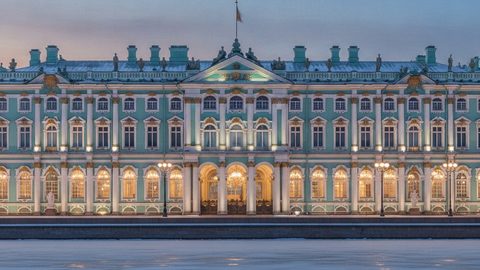
Ask yourself one question: do you want to see the Winter Palace itself or do you want to see Russian art? The Hermitage is the Winter Palace, the former imperial residence, with the Rembrandt hall, the Peacock Clock, and the Jordan Staircase as the main attractions. The Russian Museum is the institution that houses the national art collection. If your primary interest is walking through the rooms where the tsars lived, the Hermitage wins. If your primary interest is painting and sculpture from a single national tradition, the Russian Museum serves you better.
Consider crowd density. The Hermitage receives over 4 million visitors per year. The Russian Museum receives roughly half that. During peak season from May through September, the Hermitage's main complex becomes a slow-moving human river through rooms built for court ceremonies, not mass tourism. The Russian Museum's Mikhailovsky Palace stays noticeably calmer, even at midday.
Winter Palace or Mikhailovsky Palace: the Building Argument
Choose Your Architecture
The Winter Palace or Mikhailovsky Palace decision is about architecture as much as art. The Winter Palace is the larger, more opulent structure. The Jordan Staircase alone takes ten minutes to walk up, and that is before you enter a single gallery. The Mikhailovsky Palace is a smaller, more intimate neoclassical residence designed by Carlo Rossi. It was built for Grand Duke Mikhail Pavlovich, not as an imperial throne room. The rooms are proportioned for viewing art at eye level, not for impressing ambassadors.
How to Tackle the Hermitage
If you choose the Hermitage, pick one wing or a two-hour route. The total gallery length exceeds 20 km. Do not attempt to see everything. The common mistake is trying to do the Hermitage without a plan. Buy the earliest morning slot online for 10:30 AM and enter before the tour groups. Head straight for the Rembrandt hall, then the Peacock Clock, then the Impressionist works on the third floor. By 1:00 PM you will be tired enough that the museum cafe becomes a survival necessity.
How to Tackle the Russian Museum
If you choose the Russian Museum, you can complete the highlights of the Mikhailovsky Palace and the adjoining Benois Wing in two hours. The museum focuses on Russian fine art from medieval icons through the 20th century. The Russian avant-garde collection, including Malevich and Kandinsky, is one of the strongest anywhere. Start on the second floor with the icons, then move to the 18th and 19th century galleries, then finish in the Benois Wing for the avant-garde.
Worth it if
- Hermitage pros: You walk through the actual Winter Palace of the tsars. The Jordan Staircase and the Peacock Clock are unmatched anywhere in Russia. The collection spans the entire history of Western art. The General Staff Building has an exceptional Impressionist collection with far fewer queues.
- Russian Museum pros: The crowd density is roughly half of the Hermitage during peak season. You can see the highlights in two hours, not three. The museum is closed on Tuesday, not Monday, which matters if you plan a weekend trip. The Russian avant-garde section is the best in the country. The audio guide costs about the same but covers only two languages instead of eight.
- Hermitage cons: Museum fatigue hits hard here. The gallery length exceeds 20 km and you cannot see it all. The coat check queue can take 20 minutes during cruise-ship timing. Crowd density peaks between 11 AM and 2 PM. A timed entry slot is mandatory and must be booked days ahead online.
- Russian Museum cons: You see only Russian art, not world art. The building is a palace but not the Winter Palace. The audio guide is available only in Russian and English. The museum is closed on Tuesday, which is the day after the Hermitage Monday closure, meaning you cannot visit either on a Tuesday.
Skip it if
The Secret Third Option: the General Staff Building’s Impressionist Collection
There is a third option that does not require choosing between the two museums. The General Staff Building on Palace Square, which is part of the State Hermitage, holds the 19th and 21st century European and Russian art collection. This includes the Impressionist and Post-Impressionist works. The entrance is from Palace Square, opposite the Winter Palace. The queues here are far fewer than at the main Hermitage entrance.
The Impressionist collection Saint Petersburg offers here is the best in Russia. You see Monet, Renoir, Degas, Cezanne, Gauguin, Van Gogh, and Matisse. The Matisse room alone contains works that rival the collections in Paris and New York. The structure itself is a former imperial staff headquarters, not a palace, so the rooms are simpler and the lighting is better for viewing art.
If you want to split your museum day across both institutions, use the two-day split. Day one: the Hermitage main complex, meaning the Winter Palace and the Old and New Hermitage. Day two: the Russian Museum Mikhailovsky Palace and Benois Wing, plus the General Staff Building if stamina permits. The General Staff Building is also a good backup plan if you arrive at the Hermitage on a Monday and find it closed, since the Hermitage weekly closing day is Monday.
.jpg)
Museum Fatigue Saint Petersburg: How to Survive Either Choice
Pace Yourself
Museum fatigue in Saint Petersburg is a real condition. The structures are large, the floors are marble, the ceilings are high, and the rooms are connected in exhausting circuits. The Hermitage total gallery length exceeds 20 km. Walking the main complex without a plan means you will hit a wall of exhaustion at the two-hour mark, still be in the 18th century, and miss the Rembrandt hall entirely.
Rent the Audio Guide
Budget for the audio guide regardless of which museum you pick. The Hermitage audio guide languages include English, French, German, Spanish, Italian, Chinese, Japanese, and Korean. The Russian Museum audio guide is available in Russian and English only. The cost at both is roughly equivalent and is worth it for the context, especially at the Russian Museum where the icons require explanation.
Master the Cloakroom
Arrive with a plan for the coat check queue. Both museums require you to check outerwear and large bags. The free cloakroom at the Hermitage is near the Jordan Staircase entrance and fills up quickly. The Russian Museum cloakroom at the Mikhailovsky Palace entrance on Inzhenernaya Street 4 has a faster queue because the total visitor count is lower. Do not bring a large backpack. Leave it at your hotel.
Visit the museum cafe at both museums. The Hermitage cafe is in the main complex on the ground floor and serves salad, soup, and hot drinks. The Russian Museum cafe is in the Mikhailovsky Palace and is smaller. Both charge Saint Petersburg central prices, which rival Western Europe. A coffee and a pastry will cost you.
When Neither Museum is the Right Choice
The Hermitage and the Russian Museum work best for travellers who already have 3 full days in Saint Petersburg. The minimum days needed for the city are 3: one for the Hermitage core, one for the Church on Spilled Blood and a canal tour, and one for the Peter and Paul Fortress and a ballet evening. If you have only 2 days, skip one museum entirely and spend that time on the General Staff Building and a canal walk. If you have only 1 day, skip both museums and walk Nevsky Prospekt, visit the Church on Spilled Blood, and go to a ballet at the Mariinsky Theatre.
The museum choice also depends on who you are. These museums are not for travellers seeking fast-paced nightlife, for anyone who dislikes large formal museums, or for budget backpackers on a shoestring. Central costs rival Western Europe. The single thing that most often goes wrong is this: you arrive at the Jordan Staircase at 11 AM in July without a timed entry slot booked online days ahead, and you spend 90 minutes in the ticket queue only to find that the next available entry is at 4 PM, by which time museum fatigue has already won.
Read next
-

 Mid-Range Hotels: Comfortable Stays Without Breaking the Bank
Discover the best mid-range hotels in Saint Petersburg, offering a balance of comfort, location, and value. From boutique hotels on Nevsky Prospekt to modern apartments, find affordable stays that don't skimp on quality.
Mid-Range Hotels: Comfortable Stays Without Breaking the Bank
Discover the best mid-range hotels in Saint Petersburg, offering a balance of comfort, location, and value. From boutique hotels on Nevsky Prospekt to modern apartments, find affordable stays that don't skimp on quality.
-
 Best Areas to Stay in Saint Petersburg: A District Guide
Discover the best areas to stay in Saint Petersburg, from the historic centre around Nevsky Prospekt to the artsy streets of Petrograd Side. This guide covers neighborhoods, hotels, transport links, and local tips for every budget.
Best Areas to Stay in Saint Petersburg: A District Guide
Discover the best areas to stay in Saint Petersburg, from the historic centre around Nevsky Prospekt to the artsy streets of Petrograd Side. This guide covers neighborhoods, hotels, transport links, and local tips for every budget.
-
 Current Flight Routes to Saint Petersburg from Europe and Asia
A comprehensive guide to current flight routes connecting Saint Petersburg with major European and Asian hubs. Includes airline details, estimated prices, booking tips, and entry requirements.
Current Flight Routes to Saint Petersburg from Europe and Asia
A comprehensive guide to current flight routes connecting Saint Petersburg with major European and Asian hubs. Includes airline details, estimated prices, booking tips, and entry requirements.
-
 Saint Petersburg Things to Do Beyond the Hermitage and the Main Sights
Saint Petersburg rewards slowing down. Discover canal-side walks, local food halls, rooftop views, and quiet neighbourhoods beyond the Hermitage crowds.
Saint Petersburg Things to Do Beyond the Hermitage and the Main Sights
Saint Petersburg rewards slowing down. Discover canal-side walks, local food halls, rooftop views, and quiet neighbourhoods beyond the Hermitage crowds.
-
 White Nights in Saint Petersburg: What Actually Happens
Discover the reality of the White Nights in Saint Petersburg, from astronomical twilight and bridge schedules to midnight boat trips and street-level logistics. A factual guide to what actually happens during this iconic season.
White Nights in Saint Petersburg: What Actually Happens
Discover the reality of the White Nights in Saint Petersburg, from astronomical twilight and bridge schedules to midnight boat trips and street-level logistics. A factual guide to what actually happens during this iconic season.
-
 Saint Petersburg Metro: Lines, Stops, and Tips
A comprehensive guide to the Saint Petersburg Metro: history, line-by-line overview, key stations, practical tips, fares, and connection to city attractions.
Saint Petersburg Metro: Lines, Stops, and Tips
A comprehensive guide to the Saint Petersburg Metro: history, line-by-line overview, key stations, practical tips, fares, and connection to city attractions.
-
 The Hermitage and Winter Palace
A detailed guide to the State Hermitage Museum and the Winter Palace in Saint Petersburg, covering must-see collections, ticket prices, practical visiting tips, and how to navigate the complex.
The Hermitage and Winter Palace
A detailed guide to the State Hermitage Museum and the Winter Palace in Saint Petersburg, covering must-see collections, ticket prices, practical visiting tips, and how to navigate the complex.
-
 St. Isaac's Cathedral
A detailed guide to St. Isaac's Cathedral in Saint Petersburg, covering its history, architecture, the colonnade observation deck, and the lavish interior. Includes practical visitor information.
St. Isaac's Cathedral
A detailed guide to St. Isaac's Cathedral in Saint Petersburg, covering its history, architecture, the colonnade observation deck, and the lavish interior. Includes practical visitor information.
-
 Mariinsky Theatre
A practical guide to booking tickets and attending performances at the Mariinsky Theatre in St Petersburg, covering its three stages, typical repertoire, pricing, and tips for visitors.
Mariinsky Theatre
A practical guide to booking tickets and attending performances at the Mariinsky Theatre in St Petersburg, covering its three stages, typical repertoire, pricing, and tips for visitors.