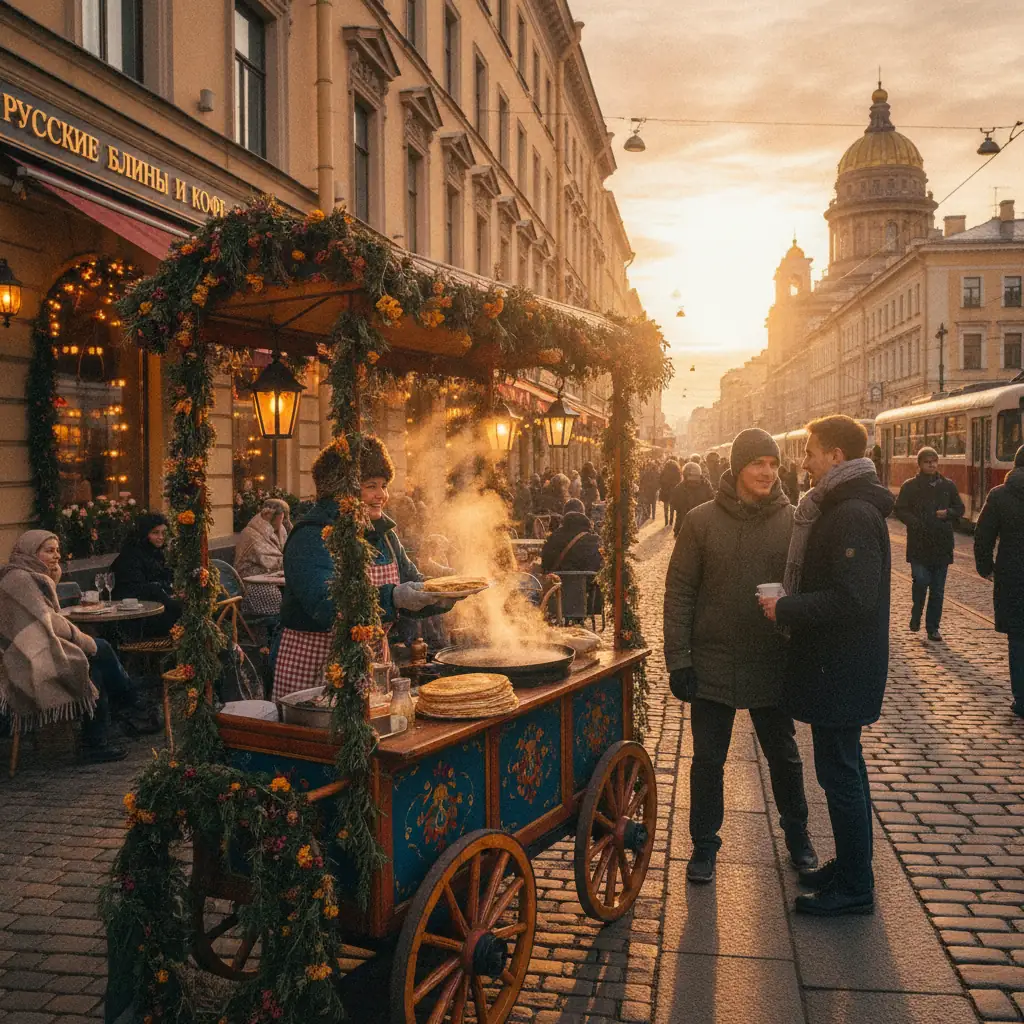
Saint Petersburg's culinary landscape has evolved rapidly in the past decade. While fine dining and historic restaurants still draw visitors to grandiose halls, the daily rhythms of the city are best tasted through its street food and neighbourhood cafes. From sidewalk stalls selling piping hot pirozhki to stylish third-wave coffee shops tucked into courtyard arches, St. Petersburg offers an accessible, affordable, and genuinely local way to eat and drink. This guide covers the essential venues, dishes, and practical tips, including prices, opening hours, and payment methods, so you can navigate the city's food scene with confidence.
Traditional Street Food Staples
Street food in Saint Petersburg is not a recent import; it has roots that stretch back to the imperial era, when vendors sold kvas, baked goods, and pickled snacks in market squares. Today, the city's most iconic street foods are both portable and filling, ideal for a day of sightseeing. Prices are generally low, between 50 and 300 rubles (approx. 0.55-3.30 EUR) per item as of mid-2025, and most vendors accept cash and, increasingly, contactless cards.
Blini (блины)
Blini are thin, crepe-like pancakes that can be sweet or savoury. They are sold from dedicated kiosks (often branded Чайная ложка, Tea Spoon, or Теремок) across the city. A typical order: a blin with sour cream and jam costs about 120-180 rubles. Fillings range from classic butter and sugar (80 rubles) to red caviar (350 rubles). Теремок on Nevsky Prospekt (near Gostiny Dvor metro) is a well-known chain; its blini are made to order, and the queue moves quickly. Another local chain, Блинофф, operates several kiosks near metro stations like Ploshchad Vosstaniya and Sennaya Ploshchad.
Pirozhki (пирожки)
Pirozhki are small baked or fried buns stuffed with meat, cabbage, potato, or apple. The best place to sample them is at a dedicated pirozhkovaya (pie shop). Notable examples include Пирожковая на Московской near Moskovskaya metro station (Moskovsky Prospekt, 193) and Булочная Ф. Вольчека on 8th Sovetskaya Street, 9. A single pirozhok costs roughly 50-120 rubles, depending on the filling. Pirozhkovayas are often open from 8:00 to 20:00, and they are a favourite among locals for a quick breakfast or lunch.
Shawarma (шаурма)
Saint Petersburg has a thriving shawarma culture. The city’s version is usually a wrap of spiced chicken or beef (sometimes lamb), cabbage, cucumber, tomato, garlic sauce, and sometimes fries, all rolled in thin lavash. Prices range from 250 to 400 rubles per serving. Notable vendors include Шаурма-бар on Rubinstein Street, 25, and the street-side stall at Ligovsky Prospekt, 50 (near Ligovsky metro). The latter is open from 11:00 to 23:00 and has a reputation for generous portions. Do check hygiene, look for stalls with high turnover and visibly clean equipment.
Kvas (квас)
Kvas is a fermented non-alcoholic beverage made from rye bread, sugar, and yeast. In summer, yellow tank barrels appear on sidewalks across the city. A typical 0.5-litre cup costs 30-70 rubles. The barrels are usually operated by local breweries such as Балтика or Степан Разин. Kvas is refreshing but carries a small amount of alcohol (0.5-1.0% ABV), so it is not suitable for children or those avoiding alcohol entirely. Always check the sell-by date printed on the barrel; a sour taste indicates spoilage.
Tea and Coffee from Stalls
Many metro stations and busy intersections have small kiosks selling hot tea and coffee in disposable cups. Tea (black or green) costs about 40-70 rubles; coffee (instant or sometimes filtered) ranges from 80 to 150 rubles. These are basic, no-frills options. For better quality, head to a dedicated coffee shop (see the Cafe Culture section below).
Cafe Culture: From Soviet-Eer to Third Wave
Saint Petersburg’s cafe scene is incredibly diverse. You can find old-fashioned pastry shops unchanged since Soviet times, bustling student cafes with prices under 200 rubles for a coffee and cake, and minimalist Third Wave coffee roasteries charging 350-500 rubles for a flat white. Many cafes also serve light meals, sandwiches, salads, soups, making them ideal for a quick, affordable lunch. Payment is increasingly card-friendly, but smaller establishments may be cash-only; always carry some rubles.
Soviet-Style Cafes
These are a time capsule of the late Soviet period (1970s, 1980s). Dishes are displayed in glass counters; you pay at a cashier, receive a receipt, and exchange it at the counter for your order. The food is simple and hearty: pelmeni (dumplings), sour cream, salads, and compote. Notable examples: Столовая №1 (Nevsky Prospekt, 114), open 9:00-22:00. A full meal (soup, main, drink) costs around 400-600 rubles. Another is Буше on Vosstaniya Street, 24, which offers a similar self-service format with a slightly wider menu and prices from 300 rubles for a main. These places are excellent for budget travellers and those seeking an authentic, no-frills experience.
Chain Coffee Shops
International chains are present but not dominant. Starbucks announced its exit from Russia in 2022, and its locations have been rebranded as Stars Coffee. You can find Stars Coffee on Nevsky Prospekt (near Mayakovskaya) and at several other central locations. Similarly, McDonald's became Vkusno & Tochka. But local chains are far more widespread. The most ubiquitous is Шоколадница (Shokoladnitsa), a coffee-and-pastry chain with scores of outlets across the city. A cappuccino costs around 200-350 rubles; a slice of cake is 150-250 rubles. Traveler's Coffee is another chain, common near the Hermitage and along Nevsky. Prices are similar. These chains offer reliable quality, free Wi-Fi, and comfortable seating, making them good spots for a rest between sightseeing. For more on navigating the city centre, see our article on walking centre.
Third Wave and Specialty Coffee
Since the 2010s, Saint Petersburg has developed a vibrant specialty coffee scene, often called “coffee revolution” by locals. Roasteries and micro-cafes focus on single-origin beans, pour-overs, and latte art. Key addresses include:
- BolsheCoffee Roasters, Ligovsky Prospekt, 74. A micro-roastery with a bright interior. A filter coffee costs 300-400 rubles. They also sell beans for home brewing (from 1,200 rubles per 250g).
- Coffee 3, Rubinstein Street, 11. This tiny spot offers espresso-based drinks using beans from local roastmaster Мечтатель. Cappuccino: 280 rubles. Limited seating.
- Lubok Coffee, Marata Street, 31. Known for its quiet courtyard and well-poured flat whites (300 rubles).
- But Coffee, Bolshaya Konyushennaya Street, 27. A favourite among students and freelancers. Espresso: 180 rubles.
Most specialty cafes are cafés with pastry and light food; many also serve breakfast until 16:00. Payment by card is standard. Check social media for opening hours, as some close on Mondays or have seasonal hours. If you plan to explore multiple cafes, consult our best areas guide to choose a neighbourhood with high cafe density, such as the Petrogradskaya side or Vasilievsky Island.
Markets and Food Halls
For a more varied street food experience, visit one of the city's renovated food markets. Here, you can sample multiple stalls in one location, often with communal seating. The most prominent is Большой Гостиный Двор (Great Gostiny Dvor), which houses a food court on its Nevsky Prospekt side with local and international vendors. Another is Сенной рынок (Haymarket), a traditional market with produce stands and a few food stalls. For a modern food hall, head to Vokzal 1853 in the former Tsarskoselsky Station (Nab. Obvodnogo Kanala, 118). It features about 20 different food counters, including Georgian khachapuri (from 350 rubles), Uzbek plov (from 400 rubles), and Japanese bowls (from 500 rubles). Open daily 10:00-23:00. Entry is free. This venue is especially convenient for groups with different tastes. For more on getting there by public transport, see our metro guide, the nearest metro is Pushkinskaya.
Specific Local Specialities Worth Seeking Out
Pyshki (Пышки)
Pyshki are deep-fried dough rings dusted with icing sugar, similar to small doughnuts. They are a true Leningrad tradition. The most famous purveyor is Пышечная на Большой Конюшенной (Bolshaya Konyushennaya Street, 25), a Soviet-era institution that has operated continuously since 1958. The interior is tiled and utilitarian; you order at the counter. A pyshka costs 30 rubles; a coffee (instant) is 50 rubles. They are open 9:00-20:00 (closed Sundays). Expect a queue. Pyshki are best eaten fresh, while still warm. This is a must-visit for a taste of Soviet Petersburg.
Pastila (Пастила)
Pastila is a traditional Russian fruit confectionery, similar to fruit leather but lighter and more aerated, often made from apples or berries. It is not strictly street food, but you can buy it in many grocery stores and at markets. Коломенская пастила (Kolomenskaya pastila) is a prized brand, available at speciality shops like ЛавкаЛавка (Marata Street, 53) and at the Елисеевский магазин (Nevsky Prospekt, 56). Prices range from 400 to 800 rubles per 200g box. It makes a good edible souvenir.
Gorodskaya Fish (Городская рыба)
In summer, vendors near the canals sell hot-smoked fish, especially snetok (a small smelt, Osmerus eperlanus) and small Baltic herring. Stalls appear around the Moyka River embankment near the Hermitage and along the Zhdanovka River on Petrogradskaya side. A portion costs 150-250 rubles. The fish is smoked on-site and sold by weight. It is a fleeting seasonal treat, best enjoyed with a cup of kvas. Always check that the fish smells fresh and is not slimy.
Practical Tips for Eating on the Street
- Payment realities: Many street vendors and small cafes accept only cash, or offer a limited ability to use cards (sometimes with a 2-5% surcharge for card payments). The city’s banking infrastructure is improving, but it is advisable to carry small denominations of rubles (50, 100, 500) for street food purchases. Larger cafes and food halls accept Visa and Mastercard issued by Russian banks; foreign-issued cards may not work due to sanctions, so check with your bank before departure. Read more about payment realities.
- Hygiene and safety: Street food in St. Petersburg is generally safe if you choose stalls with high turnover. Avoid food that has been sitting out for long periods. If you have a sensitive stomach, opt for cooked-to-order items like blini or shawarma rather than pre-made salads. Tap water is not drinkable; always buy bottled water (20-40 rubles for 0.5L).
- Language: Menus and signage are almost entirely in Russian. Learn basic Cyrillic for food items (мясо = meat, курица = chicken, рыба = fish, сыр = cheese, молоко = milk, сахар = sugar, соль = salt). Google Translate works well offline if you download the Russian language pack.
- Timing: Street food vendors typically operate from 10:00 to 21:00 or later near tourist spots. Markets are busiest on weekends. For early mornings (before 9:00), seek out a pirozhkovaya or a coffee chain. For late-night cravings (after 22:00), shawarma stalls are the most reliable option.
- Tipping: Not expected at street food stalls. In cafes, rounding up the bill or leaving 5-10% is appreciated but not mandatory.
- Etiquette: Stand in line (one queue per vendor). Do not eat while walking along Nevsky Prospekt, locals consider it a bit uncouth; find a spot to stand aside or eat in a park.
Budget and Planning
A full day of eating street food and cafe meals can cost as little as 1,000-1,500 rubles (about 11-16 EUR) per person, including breakfast, lunch, coffee, and a snack. For a more comfortable approach with a cafe lunch and a sit-down dinner, budget 2,500-4,000 rubles. If you are staying in budget accommodation, see our budget hotel guide. Also consider the added cost of travel insurance in case of food-related illness.
In summer, the White Nights season (June, July) brings extended hours for some street vendors and an especially lively atmosphere along the canals. In winter, many outdoor stalls close, but indoor food halls and market stalls remain open. Be prepared for cold weather by dressing in layers, as indoor queues in cafes can be long.
Conclusion
Saint Petersburg’s street food and cafe culture offers a genuine, affordable, and varied way to experience the city. From the fried dough of a Soviet pyshechnaya to the single-origin espresso of a modern specialty roaster, every meal tells a story of tradition, adaptation, and local taste. By following the recommendations and practical tips in this guide, you can eat like a Petersburgian, without breaking your budget or your itinerary. For a broader orientation to the city, start with our complete guide to Saint Petersburg.