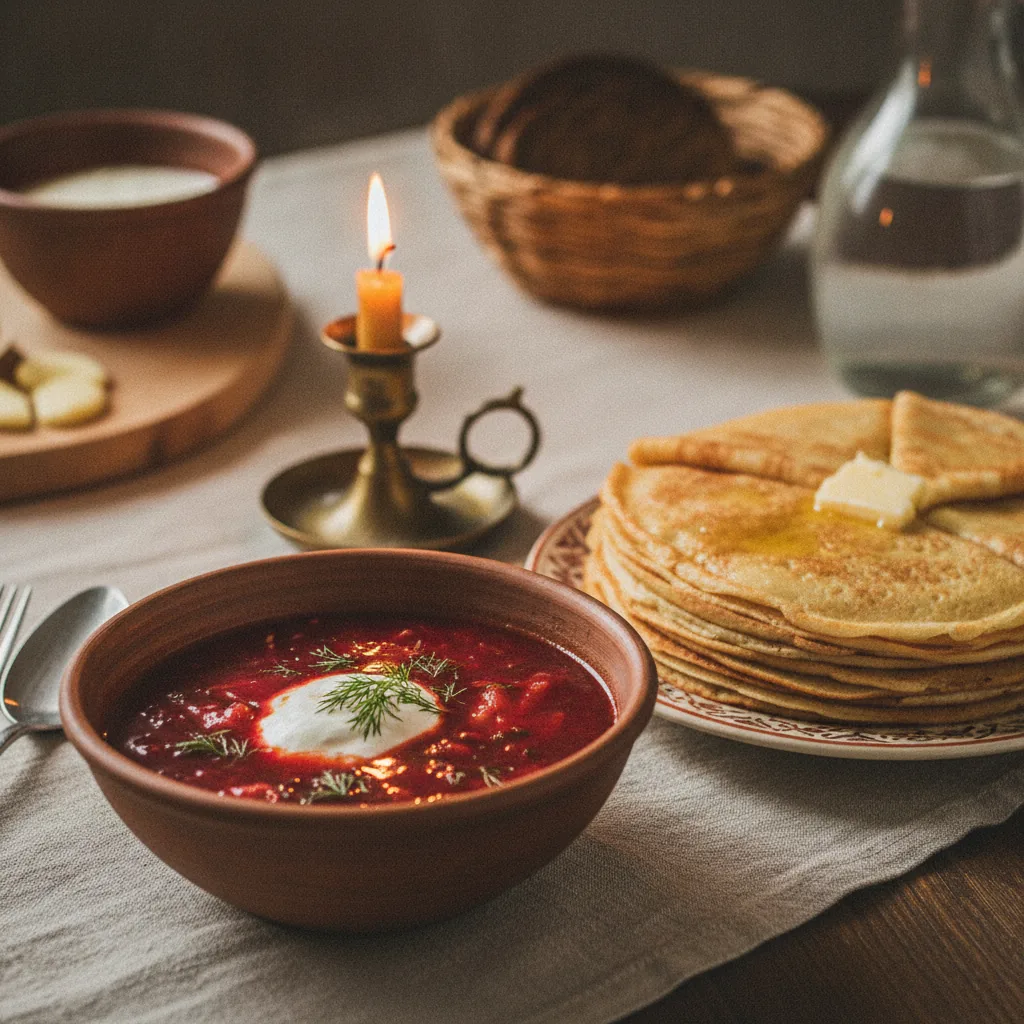
Russian cuisine is often misunderstood abroad, reduced to stereotypes of vodka, caviar, and cabbage. In Saint Petersburg, however, the food scene is both a living museum of traditional recipes and a canvas for modern interpretations. This article covers the three cornerstones of Russian home cooking, borscht, blini, and the broader repertoire of soups, pies, and preserves, then guides you to the best places to eat them in the city, from Soviet-era canteens to upscale restaurants.
The Foundations of Russian Home Cooking
Russian food is shaped by a short growing season, long winters, and the influence of Orthodox fasting calendars. Staples include root vegetables, grains, mushrooms, fermented dairy, and preserved fish. The two most iconic dishes, borscht and blini, represent opposite ends of the culinary spectrum: a hearty, slow-cooked soup and a quick, fermented pancake. Both are deeply embedded in daily life and holiday traditions.
Borscht: More Than Beetroot Soup
Borscht (борщ) is a sour soup that traditionally uses beetroot for colour and sweetness, but its defining flavour comes from fermented beet juice or, more commonly today, vinegar and tomato. The version most known outside Russia is the hot red borscht of Ukraine and southern Russia, made with beef or pork stock, cabbage, potatoes, carrots, onions, and beetroot. It is served with a dollop of smetana (sour cream) and fresh dill. A key detail: the beetroot is often sautéed separately and added toward the end to preserve its colour and texture.
Cold borscht (kholodnyk) is a summer variation based on kefir or soured milk, with boiled eggs, radishes, and cucumber. In Saint Petersburg, you will mostly find the hot version, but some restaurants offer the cold one during the White Nights season.
Nutritional profile per typical 300ml serving: about 150-200 calories, 8-12g protein, 10g carbohydrates, and 4g fat. A bowl costs 250-450 RUB in a mid-range café or 150-250 RUB in a student canteen. Real borscht should be deep ruby-red, with a balanced sourness, not cloyingly sweet. The best versions use beef stock with marrow bones and a small amount of pork fat for depth.
Blini: The Universal Pancake
Blini (блины) are thin, lacy pancakes made from a batter of wheat or buckwheat flour, milk (or kefir), eggs, and a pinch of baking soda. The batter is ladled onto a hot, greased pan and cooked quickly on both sides. Traditional blini from the 19th century used buckwheat flour and were leavened with yeast, giving them a slight tang and airy texture. Soviet-era and modern versions are often quicker, using soda and white flour.
Blini are eaten year-round but are especially associated with Maslenitsa, the week before Lent, when they symbolise the sun. Fillings range from savoury (smetana, melted butter, minced meat, mushrooms, herring, caviar) to sweet (jam, condensed milk, fresh berries, cottage cheese). A classic petrogradskaya-style blin with red caviar and smetana costs 350-600 RUB for a serving of two. Street vendors sell them for 60-120 RUB each with jam or condensed milk.
Authentic blini should be thin enough to see through but not brittle. The edges should be crisp, the middle tender. Buckwheat blini have a nutty, earthy flavour that pairs well with smoked fish and melted butter.
Where to Eat in Saint Petersburg
Saint Petersburg offers an extraordinary range of dining options, from cheap Soviet-style stolovayas to high-end restaurants serving revived pre-Revolutionary recipes. Below is a curated selection organised by type.
Soviet-Style Canteens (Stolovayas)
For the cheapest authentic meal, head to a stolovaya, a self-service cafeteria inherited from the Soviet era. These are no-frills, cash-only (some take cards), and serve big portions. A full meal (soup, main, drink) rarely exceeds 400 RUB.
- Stolovaya No. 1 (ul. Marata, 15), open daily 9:00-21:00. Known for borscht (150 RUB) and hearty mains like kotlety (minced meat patties).
- Yolki-Palki (Nevsky Prospekt, 94), a chain with a buffet concept. Borscht 180 RUB, blini 50 RUB each. Reliable and tourist-friendly.
- Koryushka (Petrogradskaya Embankment, 10), a more modern canteen near the cruiser Aurora. Try the ukha (fish soup) and buckwheat blini.
Mid-Range Traditional Restaurants
For a sit-down meal with table service and a varied menu of Russian classics, these restaurants are excellent value.
- Teremok (multiple locations, e.g., Nevsky 78), a local chain specialising in blini. Nettle blini with smetana and salmon roe (390 RUB). Note: Teremok uses soda-leavened blini, not yeast.
- Gogol (ul. Kazanskaya, 9), cosy, wood-panelled interior. Menu focuses on 19th-century Russian dishes: borscht with pampushki (garlic bread) for 320 RUB, pelmeni (dumplings) for 290 RUB.
- Dom Bellinskogo (ul. Belinskogo, 7), a two-floor restaurant with a literary theme. Their borscht is served in a ceramic pot with a bone-marrow crouton (380 RUB).
Upscale & Fine Dining
High-end restaurants in Saint Petersburg often reinterpret traditional dishes with modern techniques. Reservations are recommended.
- Birch (ul. Nekrasova, 12), a contemporary space with a tasting menu (2,500 RUB). Their blini are made with spelt flour and topped with house-cured trout and dill oil.
- Probka on Belinskogo (ul. Belinskogo, 17), an Italian-inspired restaurant but renowned for its blini buffet on Sundays. All-you-can-eat blini with six fillings, 1,200 RUB per person.
- Restoran (Bolshoy Prospekt PS, 13), an elegant Art Nouveau interior. Borscht is made with duck broth and served with a quail egg (450 RUB).
Other Essential Russian Dishes
While borscht and blini are the headline acts, visitors should also try:
- Pelmeni, boiled dumplings filled with minced beef, pork, or lamb. Served with vinegar, butter, or smetana. A dozen average 250-400 RUB.
- Shchi, a cabbage and sauerkraut soup, often fortified with sorrel in summer. More tangy than borscht.
- Kasha, buckwheat groats, often served as a side with butter and fried onions. A staple since the Middle Ages.
- Kulebyaka, a layered pie with salmon, rice, mushrooms, and eggs, wrapped in butter-rich dough. Rare today, but Khochu Kharcho (Nevsky 33) makes a good version for 450 RUB.
- Salo, cured pork fatback, thinly sliced and eaten on rye bread with garlic. Not for everyone, but a proletarian classic.
Beverages to Accompany Your Meal
Traditional Russian drinks go beyond vodka. Kefir is a fermented milk drink with a sour, fizzy taste. Kvass is a low-alcohol fermented bread drink, often flavoured with mint or berries. Mors is a sweet-sour berry drink made from lingonberries or cranberries. At a restaurant, a glass of kvass costs 60-100 RUB; a bottle of artisan kefir from local dairy Piskarevsky is about 50 RUB in a shop.
Vodka, of course, is present. Standard brands like Beluga or Russian Standard cost 300-500 RUB for a 50ml measure in a restaurant. A shot is traditionally downed in one gulp, followed by a bite of salted pickle or a piece of black bread.
Navigating Saint Petersburg for Food
Getting to the best eateries requires understanding the city's layout. The city centre is walkable, but many excellent restaurants lie off Nevsky Prospekt. Use the metro or buses and trolleybuses to reach districts like Petrogradskaya or Vasilievsky Island. For taxi services, Yandex Go or Uber Russia are reliable; expect 300-600 RUB for a 15-minute ride.
Visitors should also be aware of payment realities: many smaller cafés and stolovayas still operate cash-only or accept only Mir cards. Western credit cards (Visa, Mastercard) issued outside Russia do not work at most terminals. Bring rubles in cash or use a Russian-issued card. For up-to-date travel advisories, check government travel advisories and ensure you have travel insurance that covers medical emergencies.
Accommodation near the city centre gives you the best access to food. See our guides to budget hotels, mid-range hotels, and luxury hotels for recommendations. For a full overview of the city, start with our complete guide to Saint Petersburg.
Seasonal Eating in Saint Petersburg
The city's market halls reflect the seasons. At Kuznechny Market (Kuznechny per., 3), open 8:00-19:00, you find fresh mushrooms from the Karelian forests in September, wild berries in July, and pickled vegetables all year. In winter, root vegetables dominate: carrots, beets, celeriac, and turnips. During the White Nights (May, July), markets overflow with early dill, radishes, and strawberries. Blini with fresh berries are a seasonal must.
For a deeper dive into specific attractions, see our articles on the Hermitage, Peterhof, Catherine Palace, and St. Isaac's Cathedral, all of which have on-site cafés serving blini and borscht.
Conclusion
Russian food in Saint Petersburg is not a museum piece, it is a living, evolving tradition. From the beetroot richness of proper borscht to the buttery tang of buckwheat blini, every dish carries a story of survival, adaptation, and hospitality. The city's dining landscape offers something for every budget and palate. Whether you eat at a Soviet-era stolovaya or a Michelin-recommended tasting-menu restaurant, you will taste the same core ingredients, cabbage, root vegetables, fermented dairy, and rye, that have sustained the region for centuries.