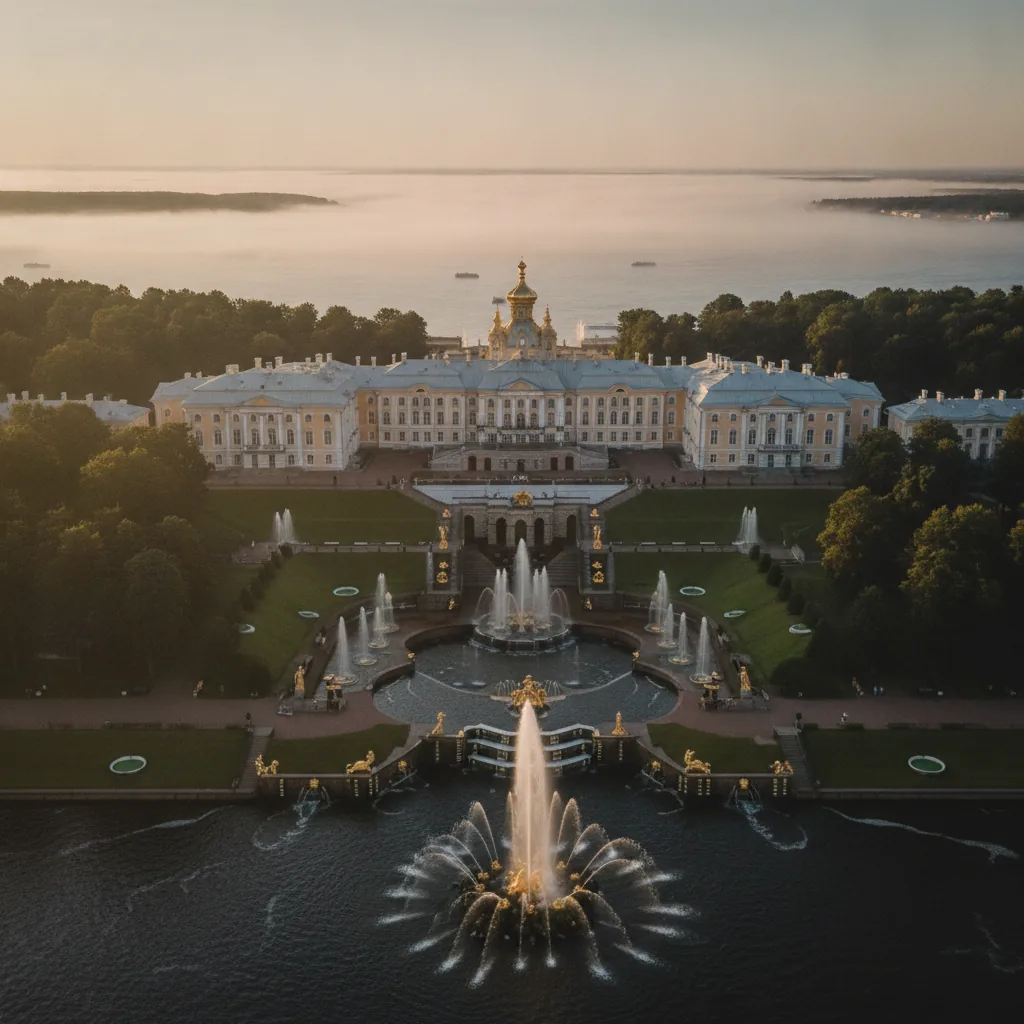
About 30 kilometres west of Saint Petersburg, on the southern shore of the Gulf of Finland, lies Peterhof, a sprawling estate of ornate palaces, manicured gardens, and more than 150 working fountains. Often called the “Russian Versailles,” Peterhof was conceived by Tsar Peter the Great in the early 18th century as a summer residence that would rival the grandeur of the French court. Today, it is a UNESCO World Heritage Site and one of the most visited suburban attractions in Russia, drawing upwards of 4.5 million visitors annually. This article provides a thorough, evidence-based overview of Peterhof’s history, key structures, fountain system, practical visitor information, and how it fits into a broader trip to Saint Petersburg.
History and Vision of Peter the Great
Peter the Great’s fascination with European architecture and maritime power directly shaped Peterhof. After his victory over Sweden in the Great Northern War (1700-1721), the Tsar sought to build a residence that would be both a symbol of Russia’s new status as a Baltic power and a personal retreat. Construction began in 1714, following a plan partly sketched by Peter himself. The site was chosen for its direct access to the Gulf of Finland, allowing the Tsar to sail directly from his capital, and for the natural springs that would power the fountains without mechanical pumps, an innovative design that remains unique today.
The estate expanded over several decades under architects such as Jean-Baptiste Le Blond, Niccolò Michetti, and later Bartolomeo Rastrelli. By the mid-18th century, under Empress Elizabeth, Peterhof had taken on its lavish Baroque character, with the Grand Palace stretching nearly 300 metres along a terrace overlooking the sea. The palace and park suffered severe damage during World War II, when German forces occupied the area from 1941 to 1944 and systematically destroyed much of the interior and many statues. Post-war restoration, a monumental state-led effort lasting into the 1970s, returned Peterhof to its former glory. Today, the museum complex includes the Grand Palace, several smaller palaces, the Lower Park, and the Upper Garden.
The Grand Palace: Baroque Splendour and Royal Apartments
The Grand Palace (Bolshoi Dvorets) is the centrepiece of the estate. Its 30-odd rooms and halls are open to the public, offering a glimpse into the ceremonial and private life of the Russian imperial family. Visitors begin their tour in the Grand Cascade Hall, then proceed through a sequence of state rooms, each more ornate than the last.
Key Rooms Worth Your Time
- The Chesma Hall, decorated with 12 large paintings commemorating the Russian naval victory over the Ottoman Empire in the Battle of Chesma (1770). The paintings, by German artist Jacob Philipp Hackert, were commissioned by Catherine the Great.
- The Throne Room, the largest hall in the palace (319 square metres), with a ceiling painting depicting allegories of Russia’s glory. The throne, made of gilded wood, dates from the reign of Empress Anna Ioannovna.
- The Chinese Cabinets, two rooms (East and West) decorated with lacquered panels, porcelain, and silk, reflecting the 18th-century European fashion for Chinoiserie. The East Chinese Cabinet contains a collection of Chinese and Japanese porcelain from the Qing dynasty.
- The Oak Study of Peter the Great, one of the few interiors preserved from Peter’s era, with carved oak panelling and a tiled stove. It was Peter’s personal working space.
The Grand Palace is best visited either early in the morning (opening at 10:30, with last entry at 15:00 in the high season) or after 14:00 to avoid the largest tour groups. The standard admission ticket for the Grand Palace in 2025 is 1,200 rubles for adults (about €12 or USD $13 at current exchange rates). Entrance to the Lower Park is purchased separately (see below).
The Fountain System: Engineering without Pumps
Peterhof’s most celebrated feature is its fountain system, a marvel of 18th-century hydraulic engineering. Unlike the fountains at Versailles, which required a costly and unreliable pump system (the Machine de Marly), Peterhof’s fountains operate entirely by gravity. Water is supplied from natural springs located on the Ropsha Heights, about 22 kilometres away, flowing through a network of canals, aqueducts, and underground pipes to a series of reservoirs in the Upper Garden. From there, a drop in elevation of about 15 metres generates enough pressure to propel water through the fountains of the Lower Park. No mechanical pumps are used, even today.
Major Fountains and Cascades
- The Grand Cascade, the largest fountain structure in Russia, comprising 64 fountains, 255 sculptures and bas-reliefs, and three cascading staircases. At its centre is the Samson Fountain, depicting the biblical hero tearing open the lion’s mouth. The lion symbolises Sweden (whose coat of arms features a lion), and the scene commemorates Russia’s victory over Sweden in the 1709 Battle of Poltava. The water jet reaches a height of 20 metres, making it the tallest fountain in Peterhof.
- The Chessboard Cascade (also called the Dragon Cascade), a tumbling water staircase flanked by three dragon-headed spouts, located in the eastern part of the Lower Park. The black-and-white-chequered marble steps give the cascade its name.
- The Pyramid Fountain, one of the most intricate, with 505 water jets arranged in a stepped pyramidal shape. It is located in the centre of the Lower Park’s main alley.
- The Sun Fountain, located near the Monplaisir Palace, this fountain features a central column that rotates, with jets of water radiating outward like sunbeams.
- The Trick Fountains, hidden jets in the park that surprise unsuspecting visitors by spraying water from the ground or from hidden sprayers near benches. These are especially popular with children.
The fountain season typically runs from early May to mid-October, with the grand opening ceremony held in mid-May. During the season, the fountains operate daily from 10:00 to 19:00, except in bad weather. The Grand Cascade is turned on at exactly 11:00 each morning with a brief musical ceremony, a spectacle that draws large crowds.
The Lower Park and Monplaisir Palace
The Lower Park (Nizhny Park) covers about 102 hectares and is the heart of the fountain display. It extends from the Grand Palace down to the shore of the Gulf of Finland, laid out in a formal French style with straight avenues, clipped linden trees, and geometric parterres. The park is divided into two main sections: the central axis centered on the Grand Cascade and the Sea Canal, and the western and eastern groves containing smaller palaces and pavilions.
Monplaisir Palace
Monplaisir (“My Pleasure”) was Peter the Great’s favourite residence, a modest two-storey Dutch-style villa built directly on the Gulf shore. It was completed in 1723 and remained largely unchanged by later monarchs. Inside, the Chinese Lacquer Cabinet features 94 lacquer panels, and the Maritime Study offers views of the sea from three sides. The kitchen is original, with Dutch Delftware tiles depicting marine scenes. Admission to Monplaisir is included in the Lower Park ticket, but an additional fee (about 500 rubles) is charged for interior visits. Monplaisir is open from 10:30 to 18:00, closed on Mondays.
Other notable features in the Lower Park include the Hermitage Pavilion, a two-storey building surrounded by a moat, used for small banquets; the Marly Palace, a small two-storey residence named after the French royal hunting lodge; and the Roman Fountains, a pair of identical two-tiered fountains in the western part of the park.
The Upper Garden: A Formal Prelude
The Upper Garden (Verkhny Sad), located to the south of the Grand Palace, covers 15 hectares and serves as the formal approach to the palace. It was laid out between 1714 and 1724, then redesigned in the mid-18th century. The garden features five ponds, geometric parterres, and three fountain groups: the Oak, the Neptune (a bronze fountain with a central figure of Neptune), and the Mezheumny (a central figure of a man with four children). Entry to the Upper Garden is free; it is open daily from 9:00 to 21:00 during the summer season. The garden is most photogenic in late June and early July, when the flowerbeds are in full bloom.
Practical Information for Visitors
Getting to Peterhof
Peterhof is located about 30 km west of Saint Petersburg’s city centre. There are three main ways to get there:
- By hydrofoil (‘Meteor’ or ‘Kometa’): The fastest and most scenic route. Hydrofoils depart from the pier near the Hermitage Museum on the Palace Embankment and arrive at the Lower Park’s pier on the Gulf of Finland. Travel time is about 40 minutes. A one-way ticket in 2025 costs 1,500-1,800 rubles (€15-18). The service runs daily from late April to October, depending on the opening of navigation.
- By marshrutka or bus: From Baltiysky Railway Station, take the local train to Novy Petergof station (40 minutes, 95 rubles), then bus 351, 352, or 357 to the Upper Garden (10 minutes, 50 rubles). Alternatively, bus 200 from Avtovo metro station runs directly to the Upper Garden (45 minutes, 60 rubles).
- By taxi or private transfer: From central Saint Petersburg, a one-way ride costs 1,200-2,500 rubles (€12-25) depending on the company and time of day. Taxi services such as Yandex.Taxi and Gett operate throughout the city.
The hydrofoil ticket is by far the most convenient, as it avoids traffic on the Peterhof Highway and drops you directly at the park entrance.
Ticket Prices and Opening Hours (2025)
- Lower Park (fountain area): 1,200 rubles (adults), 600 rubles (students and children 7-16). Children under 7 are free.
- Grand Palace: 1,200 rubles (adults), 600 rubles (reduced). Tickets for the Grand Palace are sold separately from the Lower Park.
- Monplaisir Palace: 500 rubles (adults), 300 rubles (reduced).
- Combined ticket (Lower Park + 2 small palaces): 2,200 rubles.
- Audioguide in English or Russian: 500 rubles.
The Lower Park is open daily from 9:00 to 20:00 (last entry at 19:00). The Grand Palace is open from 10:30 to 17:00 (last entry at 15:45), closed on Mondays. The Upper Garden is free and open from 9:00 to 21:00.
It is important to note that museums in Peterhof have limited capacity, and queues for the Grand Palace can exceed 1.5 hours during peak hours (11:00-14:00) on weekends and public holidays. Booking tickets online via the official website (peterhofmuseum.ru) is highly recommended, especially for the Grand Palace.
When to Visit
The best time to visit Peterhof is between late May and early September, when the fountains are running, the weather is mild (average high of 22°C in July), and the park is fully open. The peak visitor season is July and August, when crowds are at their thickest. For a more tranquil experience, visit in late May or early June, when the days are long (the White Nights phenomenon, with twilight lasting until midnight) and tourist numbers are lower. Another good option is early September, when the autumn colours begin and the crowds thin out.
Be aware that the fountain season may end as early as the first week of October, depending on weather conditions. Always check the official website before planning a visit after mid-September.
What to Bring and Not to Bring
- Bring: Comfortable walking shoes (the Lower Park covers over 100 hectares), sunscreen and a hat, a reusable water bottle (refill stations are available near the Grand Cascade), and cash (small ruble notes for tickets and souvenirs, some kiosks may not accept cards).
- Do not bring: Large backpacks or suitcases (those are not allowed inside the palaces and must be stored in luggage lockers near the entrance, costing 300 rubles for a small locker), tripods or selfie sticks (prohibited inside all museum interiors), or alcohol.
Peterhof in the Context of Your Saint Petersburg Trip
Peterhof is one of the “three imperial residences” near Saint Petersburg, along with Tsarskoye Selo (Pushkin) and Pavlovsk. It is the most convenient for a half-day trip, given its proximity to the city and the hydrofoil connection. Most visitors allocate 4-6 hours for Peterhof (including travel time), enough to explore the Grand Palace, the fountains, and Monplaisir, and to stroll through the Lower Park. If you wish to visit the Upper Garden as well, add another 30 minutes.
If you are staying in central Saint Petersburg, Peterhof is best combined with a morning at the Hermitage or a walk along Nevsky Prospekt, leaving the afternoon for a hydrofoil ride to Peterhof. Alternatively, for a full-day excursion, start early at Peterhof (arrive by 10:00), then after lunch return by hydrofoil and visit the walking centre of Saint Petersburg in the evening.
For those travelling to Saint Petersburg from abroad, it is essential to be aware of entry requirements, including visa regulations. Most nationals require a visa to enter Russia; the electronic visa (e-visa) is now available for citizens of 55 countries for stays up to 16 days. Check the latest government travel advisories before booking. Travel insurance covering medical evacuation is highly recommended.
Payment in Peterhof and Saint Petersburg has shifted significantly: since 2022, international Visa and Mastercard cards issued outside Russia do not work in the country. You will need a local payment method, either a UnionPay card (if accepted), or cash in rubles. Most ticket offices and official souvenir shops accept cash; some accept the MIR card (the Russian equivalent of Visa). It is advisable to bring enough rubles (at least 10,000-15,000 rubles for a day at Peterhof) to cover tickets, lunch, and souvenirs.
Getting Around Saint Petersburg and to Peterhof: Metro, Buses, and Taxi
The Saint Petersburg Metro is the most efficient way to reach the departure points for Peterhof (the hydrofoil pier or the railway station). The nearest metro stations to the hydrofoil pier are Gostiny Dvor (line 2) and Nevsky Prospekt (line 1), both a 10-minute walk to the pier. For the Baltiysky Railway Station, take the metro to Baltiyskaya station (line 1).
If you plan to use buses and trolleybuses within the city, note that a single fare is 60 rubles (cash) or 47 rubles via a contactless card (Podorozhnik). The bus 200 from Avtovo metro station is a low-cost option for getting to Peterhof, but the journey takes at least 50 minutes each way and can be affected by traffic.
For the return trip, keep in mind that the last hydrofoil from Peterhof to Saint Petersburg departs at 19:00 (or 20:00 in July and August). After that, you will need to rely on buses or taxis, which add at least an hour of travel time. Also note the bridge schedule if you are returning to the city centre late, the Neva River bridges open between 1:30 and 4:30 AM for shipping, potentially stranding you on Vasilievsky Island or the Petrograd Side if you are not staying in the historic centre.
For accommodation near Peterhof, most visitors prefer to stay in the city centre and travel there. However, if you wish to stay closer, the nearby town of Petergof (the administrative name of the settlement) has several budget hotels and a few mid-range hotels, but the options are limited compared to Saint Petersburg. It is generally more practical to choose a hotel in one of the best areas of Saint Petersburg, such as the Admiralteisky District or the central Nevsky Prospekt area, and make a single day trip.
If you are flying into Saint Petersburg, the closest airport is Pulkovo (LED). Several airlines operate flight routes from major European and Middle Eastern hubs, including Aeroflot, Emirates, Turkish Airlines, and Pegasus. From Pulkovo, take bus 39 or the metro line 2 (Moskovskaya station) to the city centre, then proceed to the hydrofoil pier or the railway station.
Related Articles
- The Complete Guide to Saint Petersburg, all the essential information for planning your trip.
- The Hermitage Museum, Russia’s premier art museum, located on the Palace Embankment.
- Walking the Centre of Saint Petersburg, a self-guided route past the city’s most iconic sights.
- Saint Petersburg Metro Guide, how to use the subway system, including stations with architectural interest.
- Bridge Schedule on the Neva, essential reading for anyone staying on an island.
- Taxi Services in Saint Petersburg, how to hail a cab and approximate fares.
Article last updated: February 2025. Prices and opening hours are subject to change; we recommend confirming details on the official Peterhof Museum website before your visit.