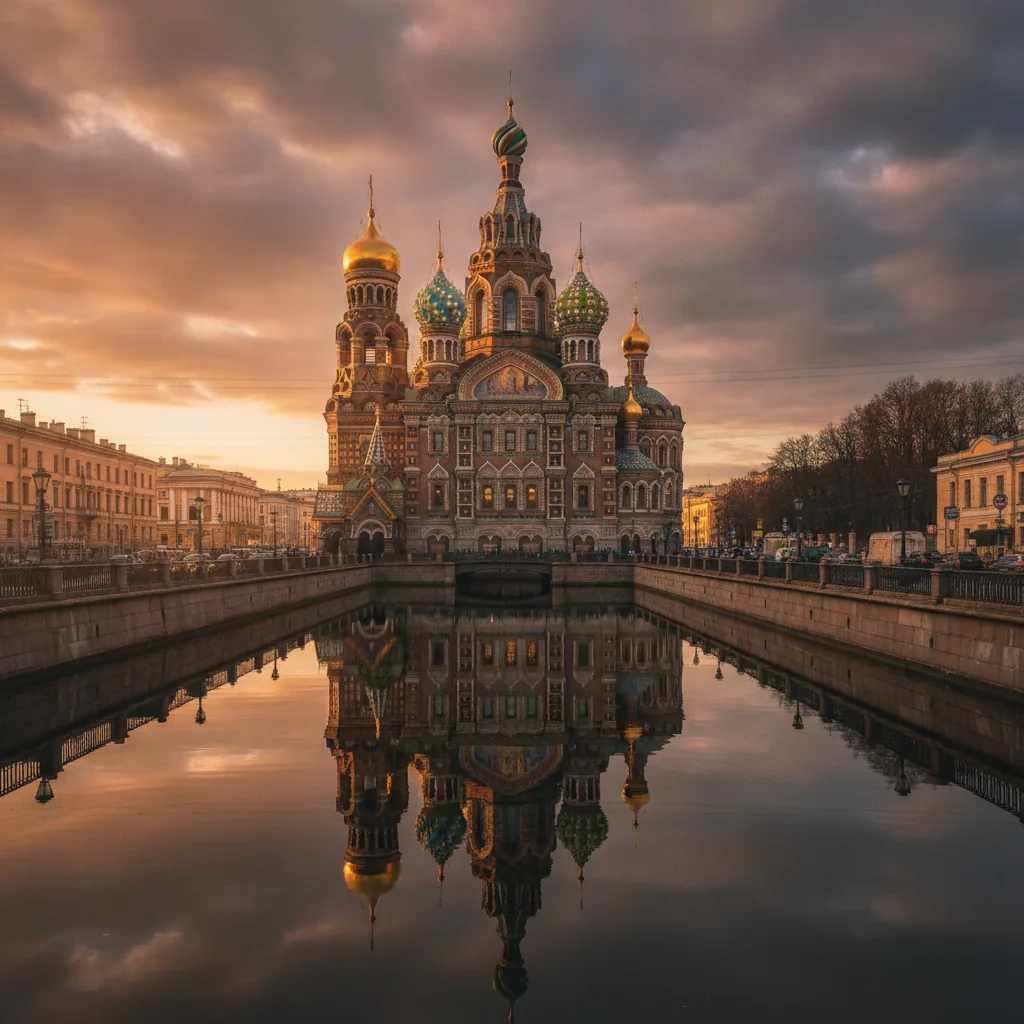
The Church of the Saviour on Spilled Blood (Спас на Крови, or Spas na Krovi) stands on the Griboyedov Canal in the historic centre of St. Petersburg. Its official name is the Cathedral of the Resurrection of Christ, but the common name refers to the assassination of Emperor Alexander II on the very spot where the church now stands. Completed in 1907, the building is one of the most recognisable landmarks of the city, with its colourful onion domes and intricate mosaic facades. Unlike the classical architecture of the nearby St. Isaac's Cathedral, the Church of the Saviour on Spilled Blood draws heavily from medieval Russian styles, making it a unique monument in the city's skyline.
Today it operates as a museum of mosaic art and a branch of the State Museum of St. Isaac's Cathedral. Visitors come to see the extraordinary interior, which is covered from floor to ceiling with over 7,000 square metres of mosaic panels. The church also serves as a reminder of a pivotal moment in Russian imperial history. This article provides a detailed overview of the church's history, architecture, mosaics, and practical information for those planning a visit to St. Petersburg.
Historical Background: The Assassination of Alexander II
The Event on the Catherine Canal
On 1 March 1881 (Julian calendar; 13 March in the Gregorian calendar), Emperor Alexander II was travelling by carriage along the embankment of the Catherine Canal (now the Griboyedov Canal). The emperor had survived several earlier assassination attempts, but that day a member of the revolutionary group Narodnaya Volya, Ignacy Hryniewiecki, threw a bomb at the imperial carriage. The explosion mortally wounded the emperor, who died a few hours later in the Winter Palace. Alexander II was known as the 'Tsar Liberator' for abolishing serfdom in 1861, and his assassination shocked the nation.
Decision to Build a Memorial Church
Almost immediately after the assassination, the city council of St. Petersburg proposed the construction of a chapel or monument on the site. The new emperor, Alexander III, wanted a more significant memorial. A competition was held for the design of a church that would both mark the place of his father's death and serve as a symbol of the triumph of Christianity over revolutionary terror. The initial winning design by Alexander Parland, an architect of Russian-German descent, was rejected by the emperor. A second competition, with the involvement of Archimandrite Ignaty (a monastic architect), produced the design that was approved.
Construction began in 1883, but the church was not consecrated until 19 August 1907, during the reign of Nicholas II. The delay was due to the complexity of the mosaic work and the need to strengthen the foundations along the canal. The total cost of construction was 4.6 million rubles, a vast sum for the time, partly raised from public donations and imperial funds.
Architecture: A Russian Revival Masterpiece
Exterior Details
The Church of the Saviour on Spilled Blood departs from the dominant Baroque and Neoclassical styles of St. Petersburg. Instead, it echoes the sixteenth- and seventeenth-century churches of Yaroslavl, Moscow, and the Russian North. The building rises to a height of 81 metres (266 feet), a number deliberately chosen to represent the year of Alexander II's death (1881). The five main onion domes are covered with enamel, ceramic tiles, and gilded metal, making them shimmer in the light. The central dome is the largest, surrounded by four smaller domes, all brightly coloured, blue, green, yellow, and red.
On the eastern side, the altar apse and a separate tent-shaped bell tower (62 metres tall) mark the precise site of the assassination. The bell tower is not typical for a Russian church of this type but was added to mark the imperial event. The exterior walls are faced with red brick, granite, and marble, with decorative kokoshnik arches, carved window frames, and intricate ceramic panels. More than 20 different types of stone were used, including Italian marble and Finnish granite.
- Height: 81 metres (central dome), bell tower 62.5 metres
- Domes: 5 main onion domes, 14 smaller domes in total
- Materials: Red brick, granite, marble, ceramic tiles, enamel, gold leaf
- Style: Russian Revival, inspired by medieval Yaroslavl and Moscow churches
Interior Layout
The interior follows a cross-in-square plan typical of Russian Orthodox churches, but the entire space is dominated by the mosaic programme. The iconostasis, which separates the nave from the sanctuary, is also made of mosaic and is set against a marble and lapis lazuli background. The floor is composed of over 40 different patterns of Italian marble, in shades of pink, grey, and white. The windows are narrow, and the interior lighting is subdued, which enhances the shimmering quality of the gold-backed mosaics.
The church can hold up to 1,200 worshippers, though it was never intended as a parish church but as a memorial. After the Russian Revolution, the church was closed and later used as a storage facility for the nearby museum of the Revolution. During the Soviet period, it fell into disrepair, and restoration work only began in the 1970s, continuing for 27 years. The church reopened as a museum in 1997.
The Mosaics: A National Treasure
The interior of the Church of the Saviour on Spilled Blood is one of the largest collections of mosaic art in Europe. The mosaics cover approximately 7,000 square metres, or about 7,000 square feet, of the walls, ceilings, domes, and pillars. The work was carried out by the mosaic workshop of the Imperial Academy of Arts under the direction of the artist Mikhail Vasilyevich Nesterov, Fyodor Bruni, and others. More than 30 artists contributed to the design of the mosaic cartoons.
Biblical Scenes and the Life of Christ
The central dome depicts Christ Pantocrator (the Almighty) in a commanding pose, surrounded by seraphim and the four Evangelists. The pendentives show the symbols of the Evangelists: the lion (Mark), the eagle (John), the ox (Luke), and the winged man (Matthew). The walls are divided into three register zones, with scenes from the New Testament, including the Nativity, the Baptism, the Crucifixion, and the Resurrection. The stories are arranged in a narrative sequence that moves clockwise around the church.
The Assassination Site as an Altar
The most unique feature of the church is the so-called 'Saviour on the Blood' chapel built directly over the place where Alexander II was mortally wounded. A small stone canopy in the form of a tented roof, made of marble and jasper, marks the exact spot. The cobblestones from the canal embankment and a section of the wrought-iron fence that stood there were preserved and built into the altar structure. This part of the church is the most solemn, and visitors can still see the original stones and a simple cross.
Mosaic Style and Technique
The mosaics were created using the Russian smalt technique, pieces of coloured glass and stone set into a plaster base. The artists used over 20,000 colours and shades, and the work required the labour of hundreds of skilled craftsmen for more than a decade. Unlike the Byzantine tradition of flat, symbolic figures, these mosaics show realistic human features, drapery, and landscape details, reflecting the influence of late 19th-century academic painting. The gold backgrounds were made by applying thin gold leaf to the reverse of the glass tiles.
- Total mosaic area: 7,000 sq m
- Number of colours used: Over 20,000
- Main artists: Mikhail Nesterov, Viktor Vasnetsov, Andrei Ryabushkin, Fyodor Bruni
- Workshop: Mosaic Department of the Imperial Academy of Arts
Practical Visitor Information
Location and Opening Hours
The Church of the Saviour on Spilled Blood is located at 2-B Naberezhnaya Kanala Griboyedova (Griboyedov Canal Embankment). It is in the very centre of St. Petersburg, a short walk from the Hermitage Museum and the Nevsky Prospekt metro station. The closest metro stations are Nevsky Prospekt (exit to Griboyedov Canal) and Gostiny Dvor (exit to Sadovaya Street). The church is open daily from 10:30 to 18:00, with extended hours until 21:00 during the White Nights period (May, July). It is closed on Wednesdays.
Ticket Prices
As of 2025, standard adult admission is 450 rubles (approx. $5 USD or €4.50). A discounted ticket for students and children (aged 7-18) is available for 200 rubles. An audioguide is available for an additional 200 rubles in English, German, French, Chinese, and Spanish. Tickets can be purchased on-site or online to avoid queues, especially during summer. The church is a popular stop on walking tours, and many visitors combine it with a visit to St. Isaac's Cathedral and the Hermitage.
Dress Code and Etiquette
Because the church is primarily a museum, there is no strict dress code, but visitors are expected to behave respectfully. Shoulders and knees should be covered out of respect for the former sacred function of the building. Photography is allowed without flash. No video recording is permitted in the mosaic area. The church no longer holds regular services, except on special occasions, so it is rarely crowded with worshippers.
How to Get There
The Church of the Saviour on Spilled Blood sits at the intersection of the Griboyedov Canal and the Nevsky Prospekt. It is easily reachable by metro, bus, taxi, or on foot from the main walking centre of the city. From the Admiralty side, walk across the Nevsky Prospekt and follow the canal embankment for about 200 metres.
By Metro: Take the blue line (M2) to Nevsky Prospekt station, or the orange line (M3) to Gostiny Dvor. From the exit on the canal side, the church is visible immediately.
By Bus/Trolleybus: Various routes stop on Nevsky Prospekt near the church, including trolleybus routes 1, 7, 10, 11, and bus routes 3, 7, 22, 27.
By Taxi: Most rides within the city centre cost between 200-400 rubles using ride-hailing apps such as Yandex Go or Uber Russia.
Restoration and Preservation
The church survived the Russian Revolution of 1917 and the subsequent Soviet era, but it suffered significant damage during the 900-day Siege of Leningrad (1941-1944). A German shell destroyed part of the dome, and the interior was exposed to the elements. After the war, the church was used as a warehouse for the nearby State Museum of the Revolution.
In 1970, a major restoration project began. The mosaics were cleaned, the domes were re-gilded, and the structural integrity of the building was repaired. The work took 27 years and cost an estimated 40 million rubles (in 1990s prices). The church was finally opened to the public as a museum on 19 August 1997, exactly 90 years after its original consecration. The restoration team had to reconstruct many of the ceramic tiles and mosaics from scratch, using medieval techniques and modern materials.
Nearby Attractions and Suggested Itinerary
Because the church is centrally located, it fits naturally into a walking route that covers the main sights of St. Petersburg. A good itinerary would include:
- The Hermitage Museum (Winter Palace), 15 minutes walk southwest through the Field of Mars
- The Russian Museum (Mikhailovsky Palace), 10 minutes walk north along the canal
- The Church of the Saviour on Spilled Blood, visit and spend 1-2 hours
- Nevsky Prospekt, stroll and shop, dine at the famous Yeliseyev Emporium (34 Nevsky)
- Kazan Cathedral (Nevsky Prospekt), free entry, 15 minutes walk
For those staying longer, the Peterhof and Catherine Palace are day trips outside the city, but the church is best combined with the city centre attractions. The area around the church is well served by budget hotels, mid-range hotels, and luxury hotels. The best areas to stay are in the central district between the Neva River and the Fontanka Canal.
Historical Significance Beyond Architecture
The Church of the Saviour on Spilled Blood is not just a beautiful building; it is a political and cultural marker. Its construction was a direct response to the assassination of a reformist emperor, and its ornate Russian style was a deliberate rejection of Western architectural trends that had dominated St. Petersburg since Peter the Great. Alexander III wanted to assert a pan-Slavic, Orthodox identity for Russia, and the church symbolises that shift.
During the Soviet period, the church was nearly demolished. In the 1930s, the authorities discussed plans to blow it up, but they decided against it due to the complexity of demolishing a building so close to the canal. Instead, it was used for storage and eventually restored. Today, it stands as a testament to the resilience of Russian artistic heritage and the complex history of the Romanov dynasty.
For visitors, the church is a vivid introduction to the way Russian rulers used architecture to legitimise their power. It is also a unique museum of mosaic art, the only one of its kind in Russia. The combination of a tragic historical narrative, dazzling craftsmanship, and a prominent location makes the Church of the Saviour on Spilled Blood an essential stop for anyone visiting St. Petersburg. For more general travel information, refer to The Complete Guide to Saint Petersburg.