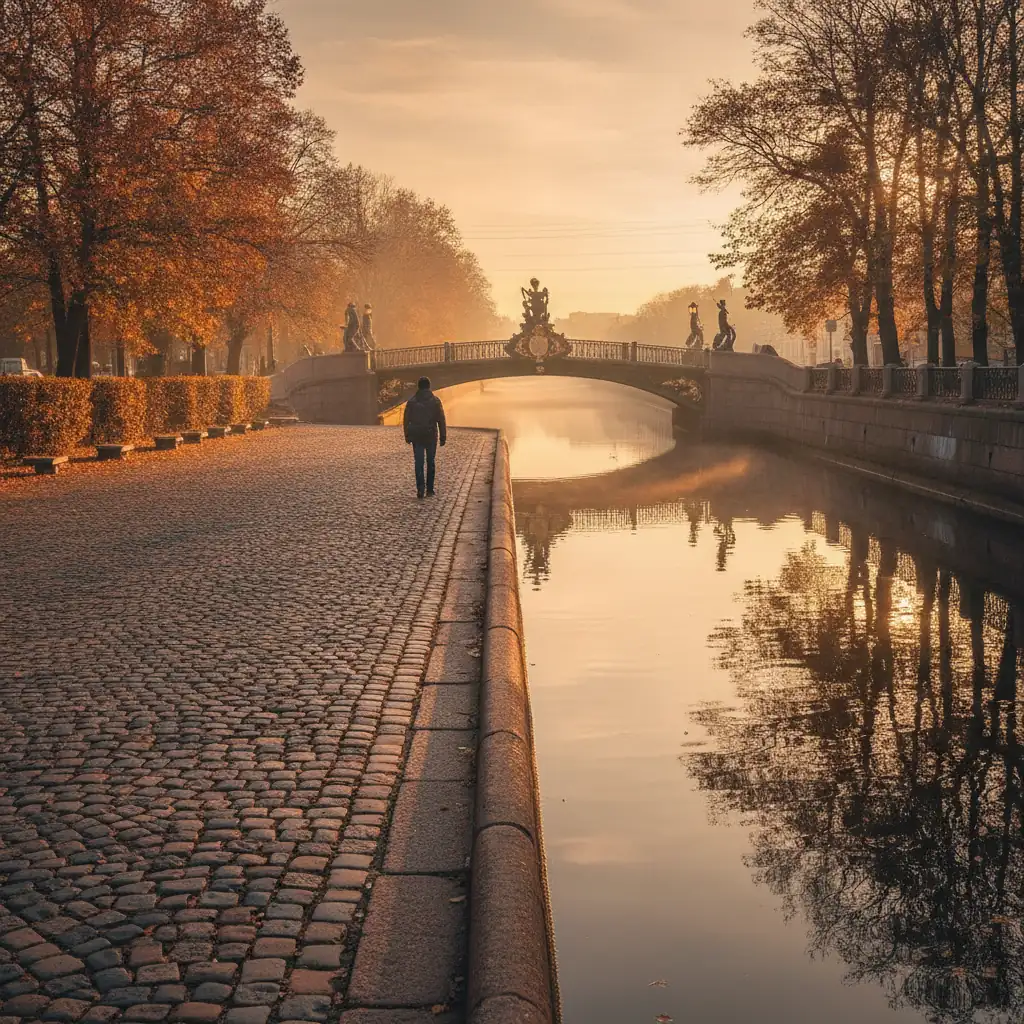
Saint Petersburg is a city best experienced on foot. Its historic core, shaped by the grid of the Admiralty and the winding waterways of the Neva delta, rewards the pedestrian with a constant shift of perspective: a palace suddenly glimpsed through a gateway, a bridge rising against the dusk, a canal reflecting a row of pastel façades. One of the most revealing walks begins on the city's main artery, Nevsky Prospekt, and leads south-east into the quieter network of canals that once formed the city's economic and social backbone. This route, roughly 4.5 kilometres from the Admiralty to the Fontanka Embankment, can be completed in under two hours at a steady pace, but deserves a full afternoon if you pause at the museums, churches, and courtyards along the way.
The walk is entirely within the central district, on well-maintained pavements and pedestrianised sections. You will cross several major roads, but traffic lights and zebra crossings are frequent. No special footwear is required, but comfortable walking shoes are recommended because the granite cobbles and paving stones can be uneven in places. The route is accessible year-round, though winter ice and summer heat call for appropriate clothing and water. For a broader orientation to the city, consult the complete guide to Saint Petersburg before setting out.
Starting Point: The Admiralty and Palace Square
Begin at the Admiralty (Адмиралтейство), the gilded spire that pierces the sky at the western end of Nevsky Prospekt. The building itself, constructed between 1706 and 1823, houses the naval college and is not open to the public, but its spire is one of the city's defining symbols. From the Admiralty, walk east along the south side of the Alexander Garden (Александровский сад) towards Palace Square (Дворцовая площадь). The square is dominated by the Winter Palace, now part of the State Hermitage Museum, and the 47.5-metre-tall Alexander Column, erected in 1834 to commemorate Russia's victory over Napoleon. The square is free to enter, and the Hermitage's main ticket office is at 2 Dvortsovaya Ploshchad. Adult admission to the Hermitage in 2024 is 500 RUB for Russian citizens and 1,000 RUB for foreign visitors; discounts apply for students and pensioners. The museum is closed on Mondays.
From Palace Square, return to Nevsky Prospekt by walking through the arch of the General Staff Building (Здание Главного штаба), which forms the southern curve of the square. This arch leads directly onto Bolshaya Morskaya Street, which meets Nevsky Prospekt at the corner of the Kazan Cathedral (Казанский собор). The cathedral, built between 1801 and 1811, is a working church and free to enter. Its 96-metre-long colonnade faces Nevsky Prospekt, creating a semi-circular plaza that is a popular meeting point.
Along Nevsky Prospekt to Gostiny Dvor
Head east along Nevsky Prospekt. The first major intersection is at Bolshaya Konyushennaya Street, where you will see the Church of the Saviour on Spilled Blood (Спас на Крови) on the Griboyedov Canal, visible from the street. The church, built on the site of Emperor Alexander II's assassination in 1881, is a museum open daily from 10:30 to 18:00 (until 21:00 in summer). Admission is 450 RUB for adults. The interior is entirely covered in mosaics, covering about 7,000 square metres.
Continuing east, the next important stop is Gostiny Dvor (Гостиный двор), the historic merchant arcade that spans an entire block between Sadovaya Street and Dumskaya Street. Built between 1761 and 1785, it is one of the earliest shopping arcades in Europe. Today it houses about 200 shops, including clothing stores, electronics retailers, and souvenir stalls. The main department store, Bolshoy Gostiny Dvor, is open daily from 10:00 to 22:00. On the opposite side of Nevsky Prospekt stands the Russian National Library (Российская национальная библиотека), with its main reading room at 36 Nevsky Prospekt. The library holds over 36 million items and offers free access to its reading rooms with a passport and registration.
At the corner of Nevsky Prospekt and Sadovaya Street you will find Kupetz Eliseevs (Елисеевский магазин), a historic delicatessen and food hall at 56 Nevsky Prospekt. The building, opened in 1903, features elaborate Art Nouveau interiors, stained glass, and a café on the second floor. A coffee and a pastry here cost around 400-600 RUB. The store sells premium chocolates, caviar, and Russian champagne.
Turning South: The Griboyedov Canal
From the intersection of Nevsky Prospekt and the Griboyedov Canal, turn south (right if you are walking east) onto the canal embankment. The Griboyedov Canal (канал Грибоедова) runs for 5 kilometres through the city centre, connecting the Moika River to the Fontanka. This section, between Nevsky Prospekt and the Fontanka, is about 1.2 kilometres long and passes several notable buildings and bridges.
The first bridge you cross is the Kazan Bridge (Казанский мост), a 18.8-metre-wide granite bridge built in 1766. Immediately after, on the left bank, stands the House of Books (Дом книги) at 28 Nevsky Prospekt, a former Singer sewing machine company building completed in 1904. Now a bookstore, it is open daily from 09:00 to 23:00. The building's glass dome and corner tower are distinctive landmarks. From the canal side, you can see the Church of the Saviour on Spilled Blood from a different angle, reflected in the water.
Continue south along the left bank of the canal. After about 300 metres you will reach the Bank Bridge (Банковский мост), a pedestrian bridge guarded by four gilded griffins, each with wings spread. The bridge was built in 1825 and connects the canal to the former Assignation Bank building, now the State University of Economics and Finance. The griffins are a popular photo spot; the originals were replaced with replicas in 2018 after corrosion damage.
Another 400 metres south brings you to the Lion Bridge (Львиный мост), another pedestrian bridge, this time flanked by four cast-iron lions. The bridge is only 24.5 metres long and was built in 1825. From here, the canal curves slightly east. On the right bank, at 73 Griboyedov Canal Embankment, is the Museum of the History of Religion (Музей истории религии), housed in the former Kazan Cathedral's almshouse. Admission is 300 RUB for adults, open Wednesday to Sunday from 10:00 to 18:00.
The Sennaya Market and the Haymarket
As you continue south, the canal passes through the area once known as the Sennaya Market (Сенная площадь). This square, now officially called Ploshchad Mira, was historically the city's main hay market and a rough, crowded district. Today it is a transport hub, with the Sennaya Ploshchad metro station (line 2) and the Spasskaya station (line 4) located here. The square is surrounded by shopping centres, including the Pik department store and the Sennaya market building, which sells fresh produce, meat, and flowers. The market is open daily from 08:00 to 20:00. Prices for fruit and vegetables here are about 20-30% lower than in central supermarkets.
Just south of Sennaya Square, the canal passes under the Sadovaya Street bridge. On the left bank, at 104 Griboyedov Canal Embankment, stands the St. Nicholas Naval Cathedral (Никольский морской собор). This Baroque church, built between 1753 and 1762, has two tiers: the lower church is dedicated to St. Nicholas, the patron saint of sailors, and the upper church to the Epiphany. The cathedral is active and free to enter; services are held daily at 10:00 and 18:00. The four-tiered bell tower is 57 metres tall and visible from the canal.
Crossing the Fontanka: From a Great Bridge to a Quiet Embankment
At the southern end of the Griboyedov Canal, you reach the Fontanka River (река Фонтанка). The canal meets the Fontanka at the Starokalinkin Bridge (Старо-Калинкин мост), a 19th-century stone bridge with four granite towers. This is the point where the canal route ends, but the walk continues along the Fontanka embankment, which offers a different character: wider, more residential, and lined with 18th-century palaces and apartment buildings.
Turn left (east) onto the Fontanka embankment. After about 200 metres you will see the Shuvalov Palace (Шуваловский дворец) at 21 Fontanka Embankment, now home to the Fabergé Museum. The museum holds a collection of nine Imperial Easter eggs, the largest such collection in the world, plus decorative arts and jewellery. Admission is 500 RUB for adults, open daily from 10:00 to 20:45 (closed Mondays from October to April). The palace itself, built in the 1780s, has restored interiors including a grand ballroom and a winter garden.
Continue east along the Fontanka. At 34 Fontanka Embankment stands the Sheremetev Palace (Шереметевский дворец), also known as the Fountain House (Фонтанный дом). Built in the 1740s, it now houses the Museum of Theatre and Music. The palace is surrounded by a large garden, open to the public. Admission to the museum is 350 RUB for adults. The garden is free and contains a pond and a statue of the composer Mikhail Glinka.
Further east, at 101 Fontanka Embankment, is the Anichkov Palace (Аничков дворец), built in the 1740s and later the residence of the imperial family. The palace is not open to the public, but the surrounding Anichkov Bridge (Аничков мост) is famous for its four horse tamer sculptures by Peter Klodt, installed between 1841 and 1850. The bridge carries Nevsky Prospekt across the Fontanka and is a busy traffic junction, but the sculptures are best viewed from the canal embankment.
Practical Information for the Walk
Below is a summary of distances, times, and costs for the full route described above, from the Admiralty to the Fontanka at the Anichkov Bridge.
- Total distance: approximately 4.5 km (2.8 miles).
- Walking time without stops: 1 hour 15 minutes at a moderate pace.
- Recommended time with stops: 2.5 to 4 hours, depending on museum visits.
- Cost of entry fees (if visiting all mentioned museums): Hermitage 1,000 RUB, Saviour on Spilled Blood 450 RUB, Fabergé Museum 500 RUB, Museum of the History of Religion 300 RUB, Museum of Theatre and Music 350 RUB = total 2,600 RUB (about €26 or $28 as of late 2024).
- Free attractions: Palace Square, Alexander Garden, Kazan Cathedral (exterior and interior), St. Nicholas Naval Cathedral, Anichkov Bridge, Bank Bridge, Lion Bridge.
The route is well served by public transport if you need to shorten it or return to your starting point. The nearest metro stations are Admiralteyskaya (line 5) at the start, Nevsky Prospekt (line 2) and Gostiny Dvor (line 3) along the way, and Sennaya Ploshchad (line 2) near the Griboyedov Canal section. For bus and trolleybus options, see buses and trolleys. A single metro ride costs 70 RUB (2024) with a contactless card or 65 RUB with a reloadable Podorozhnik card. For full metro details, read the metro guide.
Currency and payment: Most museums, shops, and cafés along the route accept credit cards (Visa, Mastercard, and UnionPay), but smaller kiosks and market stalls may prefer cash. Russian rubles (RUB) are the only legal tender. For a detailed overview of payment options, see payment realities. If you are arriving from abroad, check entry requirements and government travel advisories before your trip. Travel insurance is strongly recommended; see travel insurance for advice.
Water and restrooms: Public drinking fountains are rare; buy bottled water at supermarkets (20-40 RUB for 0.5 litres). Public toilets are available at the Hermitage (free for ticket holders), Gostiny Dvor (paid, 50 RUB), and at the Fabergé Museum (free for visitors). Many cafés will allow you to use their facilities if you make a small purchase.
Seasonal Considerations
The walk is feasible in all seasons, but conditions vary.
- Summer (June, August): Daylight lasts up to 19 hours during the White Nights (mid-June to early July). Temperatures average 18-25°C. Crowds are heavy at major attractions. Mosquitoes can be present near the canals in the evening; bring repellent.
- Autumn (September, October): Temperatures drop to 5-15°C. Rain is frequent. The canal embankments are less crowded. The Hermitage and Fabergé Museum have shorter queues.
- Winter (November, March): Daylight is short (as little as 6 hours in December). Temperatures average -5 to -15°C. Snow and ice make pavements slippery; wear boots with good grip. Many outdoor cafés close, but indoor attractions remain open. The canals may freeze, and the bridges are still passable.
- Spring (April, May): Thaw and slush are common. The canals can be grey and the weather unpredictable. The city's parks begin to bloom in May.
For flight connections to Saint Petersburg, refer to flight routes.