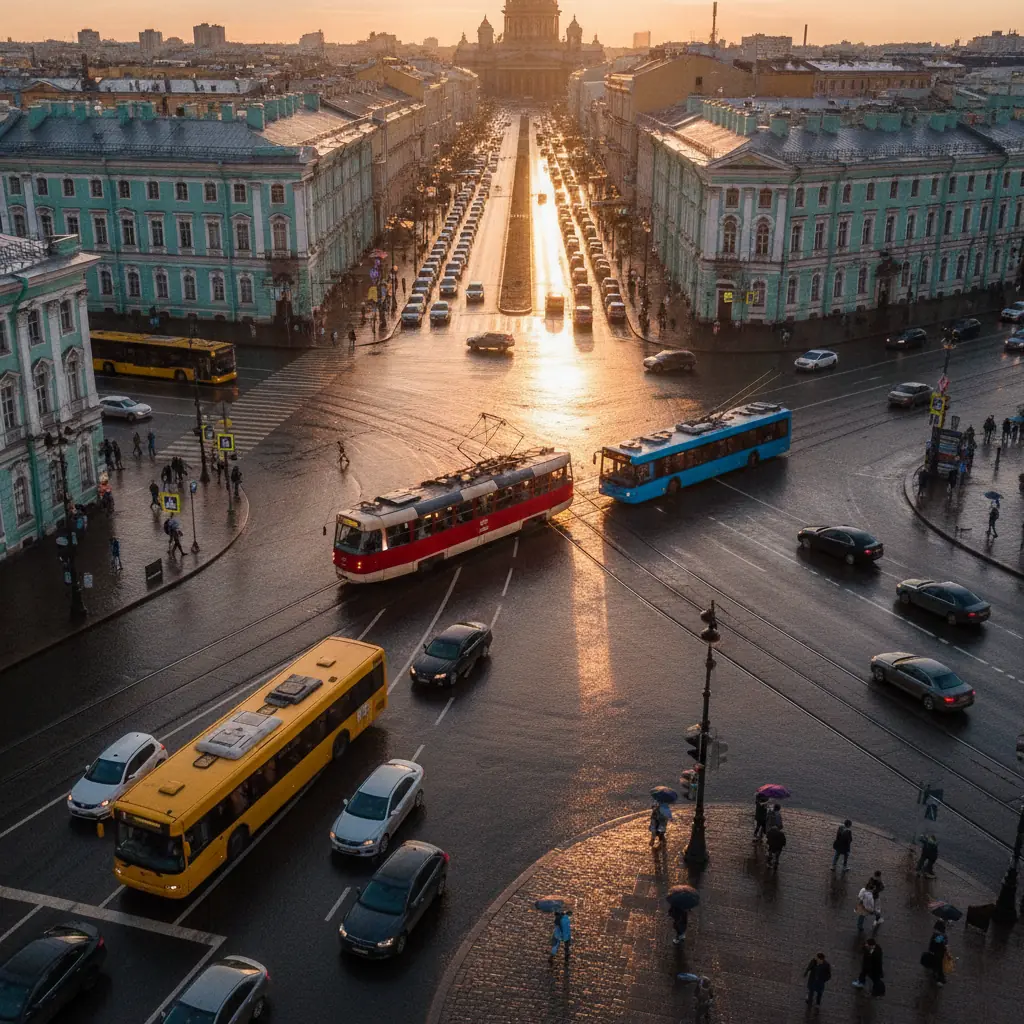
Saint Petersburg operates one of Russia's most extensive surface public transport networks, complementing its deep metro system. The city's buses, trolleybuses, and trams move millions of passengers daily across 1,439 square kilometres of urban territory. For visitors and residents alike, understanding this network is essential for efficient travel beyond the reach of the metro. This article provides a factual overview of the three surface modes, their routes, fares, operational nuances, and how they integrate with the wider transport ecosystem.
Overview of Saint Petersburg's Surface Transport Network
Saint Petersburg's surface public transport is managed by SPb GUP Passazhiravtotrans (for most municipal buses, trolleybuses, and trams) and a range of private carriers operating under municipal contracts. The network comprises over 700 routes, of which approximately 50 are tram routes, 40 are trolleybus routes, and the rest are bus services (both municipal and commercial). The system covers the historic centre, residential districts, industrial zones, and suburbs, with most routes operating from 05:30 until 00:30-01:00. Night routes (numbered with prefix "Н") run on a limited schedule between roughly 01:00 and 05:30.
Key operators and fleet
- Passazhiravtotrans, state operator running about 80% of tram and trolleybus services and a large share of municipal buses. Fleet includes low-floor models from local manufacturers (PAZ, LiAZ) and imported vehicles (Volvo, Scania).
- Private carriers, dozens of licensed companies operating smaller buses (often PAZ and Ford Transit) on routes not covered by municipal services. Tickets are usually purchased directly from the driver.
- Electrobuses (electric buses), a growing fleet (over 300 units as of 2024) on selected routes, charged via overhead pantograph at terminal stops. They replace some older trolleybus and diesel bus routes.
The entire surface network is designed to integrate with the metro. Major transfer hubs exist at stations such as Ploshchad Vosstaniya (Moskovsky Rail Terminal), Sennaya Ploshchad, and Prospekt Veteranov, where bus, trolleybus, and tram stops are within 50-100 metres of metro entrances.
Buses in Saint Petersburg
Buses are the most prevalent surface mode, covering over 500 routes throughout the city and suburbs. They fill gaps where metro lines do not reach and connect peripheral districts to the city centre and industrial zones.
Municipal buses (red and white livery)
These are managed by Passazhiravtotrans and identifiable by a red-and-white colour scheme (or, on newer models, a blue-and-white design). Fares are integrated with the unified transport card system. Key features:
- Fare: 60 rubles (single trip) if paid by contactless card (Mastercard, Visa, MIR) or transport card (Podorozhnik). Cash payment is 60 rubles (exact change required). Children under 7 travel free.
- Ticket validation: Onboard validators (yellow or blue boxes) are located near doors. Tap your card or phone (supporting NFC), a green light and beep confirm payment. Failure to validate results in a 1,000 ruble fine if inspected.
- Route numbering: Numbers 1-199 (mostly daytime), 200-400 (suburban/long-distance), and 800-900 (commercial). Night routes: Н1, Н9.
Commercial buses (yellow or white livery)
Private companies operate on routes not served by municipal buses, often with smaller vehicles. Fares are typically higher, around 60-80 rubles, and must be paid in cash to the driver (exact change preferred). These buses do not accept transport cards. They follow less rigid schedules and may not stop at all designated stops unless passengers request a stop by pressing a button or calling out.
Key bus routes for visitors
- Bus 7, runs from Petrogradskaya metro station through the centre (Nevsky Prospekt, Dvortsovaya Square) to Vasilievsky Island.
- Bus 22, connects Moskovsky Rail Terminal with the southern districts, including Pulkovo Airport area.
- Bus 39, 39A, 339, link Moskovskaya metro station to Pulkovo Airport (both terminals 1 and 2). Fare: 60 rubles. Journey time: 20-35 minutes.
- Night bus Н1, follows the route of the main metro radial (from Ploshchad Vosstaniya to Prospekt Veteranov) between 01:00 and 05:30, stopping at every metro station entrance.
Trolleybuses in Saint Petersburg
Saint Petersburg has one of the largest trolleybus networks in Europe, with nearly 40 routes and over 400 km of contact wire. Trolleybuses are electric vehicles drawing power from overhead lines via two poles. They operate in the central districts, major avenues (Nevsky Prospekt, Ligovsky Prospekt, Moskovsky Prospekt), and several residential areas. Unlike trams, they do not require rails, so they share road space with other traffic.
Current fleet and modernisation
The city is gradually replacing its Soviet-era ZiU-9 and VZTM trolleybuses with new low-floor models such as the Trans-Alfa 6281 (produced in Engels, Saratov Oblast) and the PKTS 6281 (from St. Petersburg's own plant, PC Transport Systems). These newer vehicles have air conditioning, USB charging ports, and electronic route displays. As of 2025, about 40% of the trolleybus fleet is low-floor.
Fares and payment
Identical to municipal buses: 60 rubles per trip via contactless card, Podorozhnik transport card, or cash (exact change). The same ticket validation rules apply. Transfers between trolleybus routes (and between trolleybus and bus) are not free, each boarding requires a new fare.
Notable trolleybus routes
- Trolleybus 1, a historic circular route around the central core, connecting Ploshchad Lenina, Nevsky Prospekt, and the Admiralty.
- Trolleybus 5, runs from Sennaya Ploshchad southwest to Dachnoye, serving the southern residential districts.
- Trolleybus 11, connects Ploshchad Vosstaniya (Moskovsky station) with the Petrograd Side, crossing the Bolshoy Petrovsky Bridge.
- Trolleybus 26, a long radial route from Ligovsky Prospekt to the southern suburb of Kupchino.
Trolleybuses are generally slower than metro but avoid the congestion of some central streets because they use dedicated lanes on certain sections (e.g., along Moskovsky Prospekt). They are also quieter and emit no exhaust fumes, a clear advantage in the city's historic centre.
Trams in Saint Petersburg
Saint Petersburg once boasted the world's largest tram network, in the 1980s it exceeded 600 km of track. Although many lines were dismantled in the 1990s and 2000s, the system remains the third largest in Russia (after Moscow and Samara) with about 40 routes and 200 km of double-track. Trams are most prevalent in the southern districts (Kupchino, Dachnoye, Rybatskoye) and the western part of Vasilievsky Island, but they also serve the centre along selected streets like Sadovaya Ulitsa and Rimskogo-Korsakova Prospekt.
Fleet modernisation
Since 2018, the city has been purchasing new trams as part of a major renewal programme. The dominant modern models are:
- 71-911 (City Star), three-section articulating tram produced by PK TS (St. Petersburg). Features include 100% low floor, air conditioning, electronic information panels, and interior CCTV.
- 71-931 (Vityaz-M), five-section articulated tram built in Tver. Similar amenities, used on high-passenger routes.
- LVS-2005 (older model, still in service), two-section high-floor trams produced in St. Petersburg. They are gradually being phased out.
As of early 2025, approximately 55% of the tram fleet is low-floor. The city aims to reach 75% by 2027.
Fares and transfers
Same as municipal buses and trolleybuses: 60 rubles per trip. Trams accept all payment types (contactless cards, Podorozhnik, cash with exact change). Children under 7 travel free. There is no free transfer between tram lines or between tram and other modes within a single journey.
Key tram routes
- Tram 6, operates from Ploshchad Vosstaniya (near Moskovsky station) southwards to the Kupchino district, passing through the large freight area near the St. Petersburg Sortirovochny station. It uses modern Vityaz-M trams.
- Tram 19, runs from the Petrograd Side (Sportivnaya metro) along the Bolshoy Prospekt, crossing the Neva via the Tuchkov Bridge to Vasilievsky Island.
- Tram 40, connects the southern terminus at Prospekt Veteranov metro with the suburb of Uritsk, partly on segregated track.
- Tram 52, a radial route from the centre (Sennaya Ploshchad) to the southern industrial zone Dachnoye, known for frequent service.
- Tram 100, a historical line using retro-style trams on summer weekends (May, September). It runs along the embankments of the Neva and Fontanka rivers from Ploshchad Truda to Botanicheskaya Ulitsa.
Trams in St. Petersburg are generally reliable but are susceptible to delays caused by traffic on shared road sections and by winter snowfall. The city maintains a dedicated track repair programme, and as of 2024, about 85% of tracks were in good or satisfactory condition. The average speed of a tram is 14-18 km/h, compared to 40 km/h for the metro.
Fare Payment and Travel Cards
Saint Petersburg uses a unified electronic fare system for all municipal surface transport and the metro. The key payment methods are as follows:
Podorozhnik transport card
A rechargeable contactless smart card available at metro ticket offices and automated vending machines (spotted at all metro stations and selected bus terminals). Cost: 60 rubles (refundable deposit). The card can be topped up in amounts from 50 to 3,000 rubles. Benefits:
- Single trip on any surface transport: 39 rubles (vs 60 rubles cash).
- Metro trip: 47 rubles (vs 65 rubles single ticket).
- 90-minute unlimited transfer: 68 rubles (covers all metro, bus, trolleybus, tram within 90 minutes, up to 6 trips).
This card is the most cost-effective option for anyone making 3 or more trips per day. It can be used by multiple passengers (each taps the card separately) but only one trip at a time per card.
Contactless bank cards and mobile wallets
Visa, Mastercard, MIR, and UnionPay contactless cards (as well as Apple Pay, Google Pay, Samsung Pay) are accepted on all municipal buses, trolleybuses, and trams. Tap the validator, a single fare of 60 rubles is charged. No sign-up or registration required. Foreign-issued Visa/Mastercard cards may face issues due to sanctions, see Payment Realities for current details.
Cash payment
On municipal vehicles, cash (coins only, exact change) is inserted into a fare box near the driver. The driver does not give change. On commercial buses, cash is handed directly to the driver (fares 60-80 rubles). Cash is not accepted on trams or trolleybuses in most newer vehicles, only card or Podorozhnik. Always carry a backup card or Podorozhnik.
Practical Tips for Using Surface Transport
Finding routes and stops
- Yandex.Transport (mobile app) provides real-time tracking for all buses, trolleys, and trams, with estimated arrival times and route maps. Available in English.
- 2GIS offline map includes all surface routes and stop locations with schedules.
- Stop signs are blue-and-white rectangles showing route numbers and a small map. In the centre, many stops have electronic displays showing arrival times (in Russian).
Boarding and etiquette
- Enter through the front door (especially on buses and trolleybuses without a central door validator). Trams often allow boarding through any door.
- Validate your ticket immediately upon boarding. If using Podorozhnik, hold it on the yellow validator until the green light appears. If using a bank card, hold until the beep. Do not remove the card too early.
- Offer your seat to elderly passengers, parents with small children, and disabled travellers. It is customary to say "Спасибо" when someone gives up a seat.
- Have your fare ready before the stop.
Safety and customs
- Keep valuables secure, pickpocketing can occur on crowded vehicles, particularly on routes 7, 22, and the night buses.
- Do not eat or drink on board. Fines for eating/drinking range from 500 to 1,000 rubles.
- Smoking is strictly prohibited on all vehicles.
- If you need to get off at the next stop, press the red button ("СТОП") located on handrails or above doors, usually before reaching the stop. Drivers do not automatically stop at every stop.
Luggage
Large suitcases are allowed, but you may be asked to pay an extra fare if the luggage exceeds 120 cm in total dimensions. Bicycles are permitted only if folded or packed in a cover (trams and trolleybuses generally allow unfolded bikes if not crowded, but bus drivers have discretion).
Integration with Metro and Other Transport
The surface network is designed to complement the metro. Most metro stations have adjacent bus/trolley/tram stops with synchronized schedules (buses often wait at terminals to meet arriving trains). For travel beyond the city limits (suburbs like Pushkin, Pavlovsk, Peterhof), suburban buses (which are not covered by the 60-ruble fare) depart from metro stations such as Moskovskaya, Prospekt Veteranov, and Parnas. Fares for suburban buses range from 60 to 180 rubles depending on distance, pay cash or use a dedicated suburban transport card.
Trolleybuses and trams are increasingly being paired with dedicated lanes (e.g., along the southern embankment of the Obvodny Canal and on Moskovsky Prospekt), allowing them to bypass car traffic. The city's transport committee publishes annual plans for expanding these lanes, as of 2025, 18 km of dedicated tram and trolleybus lanes exist, with 5 km under construction.
For tourists arriving by air, the best surface option to reach the city centre from Pulkovo Airport is bus 39 or 39A to Moskovskaya metro (60 rubles), then metro onwards. Alternatively, the express bus 39Э (same fare) runs non-stop to Moskovskaya. For those with heavy luggage, official airport taxis cost 1,000-1,500 rubles to the centre, see flight routes for more airport transport details.
Challenges and Recent Developments
Despite the efficiency of the network, surface transport in St. Petersburg faces several challenges:
- Traffic congestion, especially on central streets like Nevsky Prospekt, Ligovsky, and Bolshoy Prospekt P.S. During peak hours (08:00-10:00 and 17:00-19:00), average bus speeds drop below 10 km/h.
- Winter impacts, heavy snowfall, common from December to March, can delay trams due to frozen switches and reduce trolleybus speeds on icy overhead wires. Salt and sand are applied, but delays of 15-30 minutes occur a few times per season.
- Ageing infrastructure, some tram tracks laid in the 1960s, 70s remain in use, causing rough rides and occasional derailments. The city has earmarked 12 billion rubles for track replacement between 2024 and 2028.
- Disparity between municipal and commercial buses, Commercial buses often lack accessibility features, have inconsistent schedules, and are less regulated. Complaints about drivers skipping stops or aggressive driving are reported on routes 100-200 series.
- Payment method limitations for foreign visitors, Due to sanctions, Visa and Mastercard cards issued outside Russia may not work on validators. It is advisable to buy a Podorozhnik card with cash or use a UnionPay card (which works reliably). See Payment Realities and Entry Requirements for more details.
On the positive side, the city has launched a programme to install real-time passenger information displays at 200 stops in the historic centre by the end of 2025. The first 50 displays were activated in 2024 near major landmarks such as Dvortsovaya Square, Nevsky Prospekt, and Vasilievsky Island. The city is also testing autonomous electric buses on a limited route along the Neva embankment (Line 2024).
Conclusion
Saint Petersburg's buses, trolleybuses, and trams provide an extensive, affordable, and generally reliable way to navigate the city. The system works best when used in combination with the metro, especially for longer cross-city journeys. Tourists and new residents should equip themselves with a Podorozhnik card and a route-finding app like Yandex.Transport, and plan extra time during peak hours. By understanding the fare system, route numbering, and boarding etiquette, anyone can confidently ride the surface network and explore every corner of Russia's historic northern capital. For a broader overview of visiting the city, see The Complete Guide to Saint Petersburg.