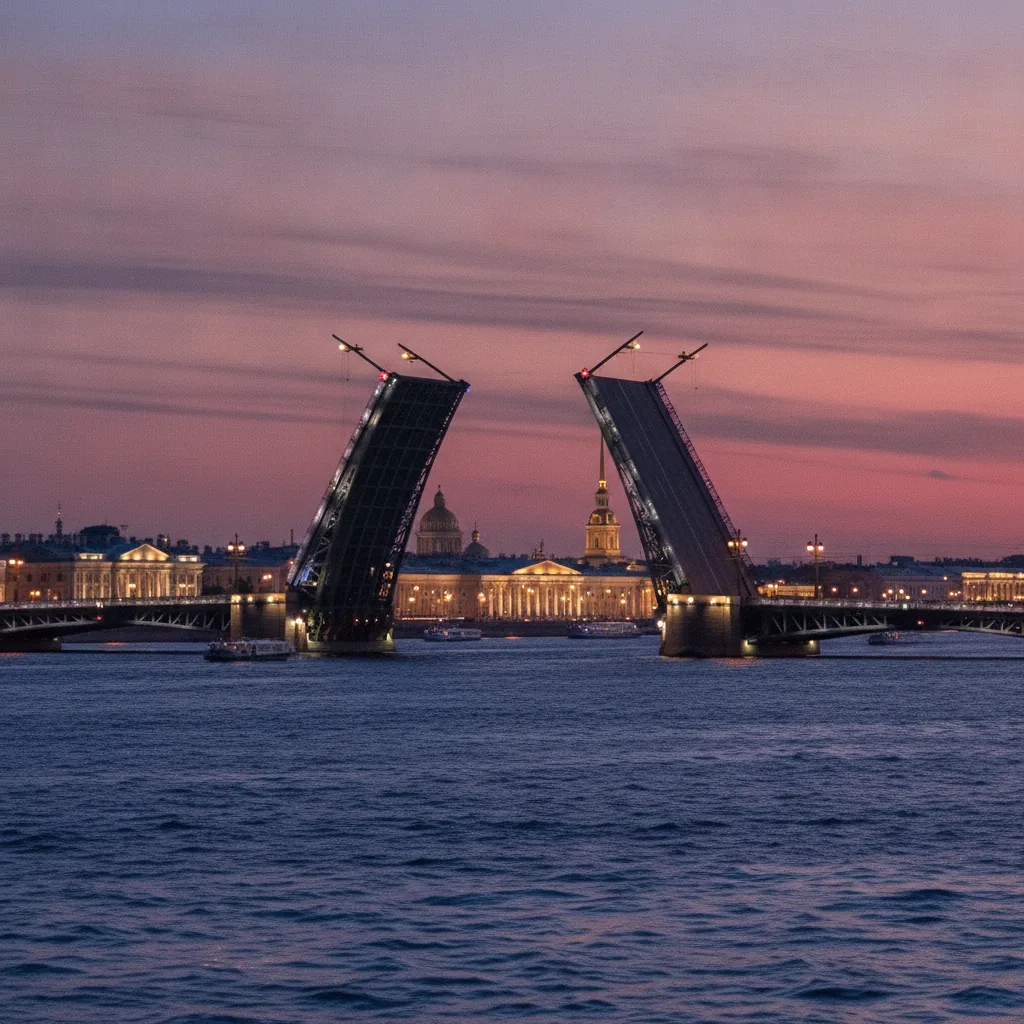
Saint Petersburg is famously a city of islands, canals, and rivers. The Neva River and its tributaries are crossed by hundreds of bridges, but during the navigation season, roughly from April to November, many of the central drawbridges are raised nightly to allow cargo ships and cruise vessels to pass. This phenomenon, known locally as razvodka mostov (разводка мостов), is both a spectacular sight and a logistical challenge for residents and visitors alike. Understanding the bridge-raising schedule and planning your movements accordingly is essential for anyone staying in the city during the warmer months.
This article explains the timings, the most affected bridges, how to check real-time status, and practical strategies, including using overnight public transport, staying on the correct side of the river, and booking accommodation strategically. Whether you are attending the White Nights festivals or simply exploring the city in summer, knowing when and where bridges open will save you from being stranded on the wrong bank until dawn.
Why Bridges Are Raised
Saint Petersburg is Russia's largest port on the Baltic Sea. The Neva River connects Lake Ladoga to the Gulf of Finland, and during the navigation season (typical dates: 10 April to 30 November, though exact dates vary yearly by decree of the Baltic Basin Water Administration), the river must accommodate vessels with masts or superstructures too tall to pass under fixed bridges. The drawbridges are raised according to a published schedule, usually between 01:00 and 05:00, though some bridges open earlier or later depending on ship traffic.
The raising of bridges is not arbitrary, it is coordinated by the State Unitary Enterprise Mostotrest (Мостотрест), which manages the city's bridges and publishes the official timetable. During the White Nights period (late May to mid-July), the spectacle of a bridge opening against the pale night sky draws crowds of tourists and photographers to the embankments.
Key Bridges and Their Schedules
The most famous bridges are those in the historic centre. Below is a general schedule based on typical years (2023-2024 data). Always check the official Mostotrest website or a reliable app for the current year's exact times, as schedules can shift by 15-30 minutes.
Palace Bridge (Дворцовый мост)
Connecting Palace Embankment (near the Hermitage) to Vasilyevsky Island. It is the most photographed bridge in the city. Typical schedule: 01:10-02:50 and 03:10-04:55. However, the second span is often shorter; the bridge may close earlier if no ships are waiting.
Trinity Bridge (Троицкий мост)
Links the Trinity Square area with the Petrograd Side. Typical schedule: 01:20-04:50. This bridge has a single long opening window.
Liteyny Bridge (Литейный мост)
Connects Liteyny Prospekt with the Vyborg Side. Typical schedule: 01:40-04:45.
Bolsheokhtinsky Bridge (Большеохтинский мост)
Also known as Peter the Great Bridge, it connects the Central District with the Malaya Okhta area. Typical schedule: 02:00-05:00.
Alexander Nevsky Bridge (Мост Александра Невского)
Connects the central part of Nevsky Prospekt with the right bank. Typical schedule: 02:20-05:10.
Blagoveshchensky Bridge (Благовещенский мост)
Formerly known as Lieutenant Schmidt Bridge, it connects Vasilyevsky Island with the Central District near the Mining Institute. Typical schedule: 01:25-02:45 and 03:10-05:00.
Note that bridges on the Neva delta (such as the Volodarsky, Finlyandsky, and Kantemirovsky) have different schedules, often opening earlier or later. The official timetable should be consulted before planning any late-night crossing.
How to Check Real-Time Bridge Status
Several tools allow you to see whether a bridge is currently raised or closed, and when it is due to open:
- Mostotrest website (mostotrest-spb.ru), the official source with a daily PDF schedule and a live map showing bridge status (green = open, red = raised).
- Yandex.Maps, the app shows real-time bridge status overlays on the map. It also suggests alternative routes when a bridge is raised.
- 2GIS, similar functionality to Yandex, with public transport routing that accounts for bridge openings.
- Telegram bots, several unofficial bots (e.g., @mostotrest_bot) provide schedule queries and alerts.
For visitors without a Russian SIM card, downloading offline maps (such as Maps.me or 2GIS) with cached data is recommended, though live updates require internet access. Free Wi-Fi is available in many hotels, cafes, and metro stations.
Navigating the City When Bridges Are Raised
If you are on the wrong side of the river when a bridge opens, you may have to wait until it closes, which can be several hours. Here are the main strategies to avoid being stranded.
Stay on the Same Side as Your Accommodation
The simplest tactic is to plan your evening itinerary so that you end up on the same bank as your hotel or apartment. The historic centre (Nevsky Prospekt, Admiralteyskaya, Gostiny Dvor) is on the left (south) bank of the Neva, while Vasilyevsky Island and the Petrograd Side are on the right (north) bank. If you are staying on Vasilyevsky Island, avoid crossing to the mainland after midnight unless you are prepared to wait until the bridges close, typically around 05:00-06:00.
Use the Metro Before It Closes
The Saint Petersburg Metro operates from about 05:40 to 00:30 (some stations close earlier). The last trains depart from central stations around 00:15-00:30. If you need to cross the Neva, the metro is the fastest option before midnight. After that, you must rely on surface transport or wait. The metro does not run during bridge-raising hours, so you cannot use it to cross after 00:30.
For more about the metro system, see our Metro Guide.
Overnight Bus Routes (Nochnye Avtobusy)
From late April to mid-November, the city runs special overnight bus routes that operate when bridges are raised. These buses cross the Neva using the only bridges that are not raised: the Volodarsky Bridge (south-east) and the Finlyandsky Railway Bridge (north-west), which have a different schedule. However, these bridges are also raised for a short period (usually 02:30-04:30), so overnight buses may be delayed or rerouted.
The main overnight routes are:
- No. 1M (from Moskovskaya metro to Nevsky Prospekt, then to Vasilyevsky Island via the Blagoveshchensky Bridge before it opens).
- No. 2M (from Krestovsky Ostrov to the city centre via the Troitsky Bridge).
- No. 3M (from Rzhevka to the city centre via the Alexander Nevsky Bridge).
These buses run approximately every 20-30 minutes from 00:30 to 05:30. Fares are standard (65 RUB as of 2024). You can pay with the Podorozhnik card, a contactless bank card, or cash (though change is rarely given). For more on bus travel, see Buses and Trolleys.
Taxis and Ride-Hailing
Taxis can cross raised bridges only if the bridge is closed. During the raising period, taxis will take long detours via the Volodarsky or Finlyandsky bridges, which can significantly increase the fare and travel time. For example, a trip from Nevsky Prospekt to Vasilyevsky Island normally costs 300-400 RUB and takes 15 minutes. During bridge-raising hours, the same journey may cost 800-1,200 RUB and take 40-60 minutes. Ride-hailing apps like Yandex Go and Uber (operated by Yandex in Russia) show the estimated fare before booking, and they factor in bridge status.
For more on taxis, see Taxi Services.
Walking Across the Bridges
Pedestrians are allowed to cross drawbridges on foot, but only when the bridge is closed. Once the bridge begins to raise, barriers are lowered and guards prevent access. You cannot walk across a raised bridge. However, you can wait at the barrier until the bridge is lowered (usually after 05:00). Many tourists choose to watch the raising from the embankment and then walk across after the bridge closes again.
Planning Your Itinerary Around Bridge Schedules
If you are visiting during the White Nights (June, July), when the sun barely sets, you may want to see the bridges raised, it is a iconic experience. But you must plan your return. Here are practical tips:
- Check the timetable in advance. Print a copy or save a screenshot on your phone. The official schedule is published on the Mostotrest website about a week before the navigation season starts.
- Book accommodation on the same side of the river as your main activities. If you plan to spend most evenings in the historic centre, stay on the left bank. If you prefer the Petrograd Side or Vasilyevsky Island, stay there.
- Use the metro before midnight. The last train from Nevsky Prospekt to Vasilyevsky Island departs around 00:20. After that, you must use overnight buses or taxis.
- Consider a river cruise. Many evening cruises pass under the bridges just before they raise, offering a unique view. These cruises typically return to the dock before 01:00.
- If you are staying on Vasilyevsky Island and attending a late event in the centre, plan to return before 01:00 or after 05:00. The same applies in reverse.
Bridge-Raising Season Dates and Variations
The official navigation season runs from 10 April to 30 November, but the exact start and end dates are confirmed by the Baltic Basin Water Administration each year. In recent years, the season has sometimes started in late April due to ice conditions. During the winter (December, March), the bridges are not raised, and the Neva freezes over. However, some small bridges on canals may be raised year-round for maintenance.
During the season, there are occasional technical breaks when bridges are not raised for a night or two, for example, during major holidays (Victory Day, 9 May; City Day, 27 May) or when ship traffic is minimal. The Mostotrest website posts these exceptions.
It is also worth noting that during the Scarlet Sails festival (usually in late June), the bridge-raising schedule is altered: the Palace Bridge remains closed for several hours to allow the show to proceed, and then opens later than usual. Check the official city events calendar for exact dates.
What to Do If You Get Stranded
Despite all planning, you might find yourself on the wrong bank after the bridges have raised. Here is what to do:
- Wait at a 24-hour café or bar. Many places near the embankments stay open all night during the White Nights. For example, Bushe (on Bolshaya Konyushennaya) and Stolle (on Malaya Morskaya) are open 24/7. You can have coffee, pie, or a light meal while you wait.
- Take an overnight bus. Check the route map on 2GIS or Yandex.Maps. Buses 1M, 2M, and 3M run all night. They may not go exactly where you need, but you can get close and walk the remaining distance (the city is generally safe at night).
- Call a taxi via Yandex Go. The app will show the detour route and estimated fare. Be prepared for a longer journey and higher cost.
- Walk to the nearest bridge that is still closed. The Volodarsky Bridge (south-east) and Finlyandsky Bridge (north-west) have shorter raising windows, sometimes only 30 minutes. If you can reach those bridges before they open, you may cross on foot. However, check the schedule first.
Practical Information for Visitors
Here is a summary of key facts:
- Official schedule source: Mostotrest (mostotrest-spb.ru).
- Typical season: 10 April, 30 November.
- Peak raising hours: 01:00-05:00.
- Most affected bridges: Palace, Trinity, Liteyny, Bolsheokhtinsky, Alexander Nevsky, Blagoveshchensky.
- Bridges that remain open (usually): Volodarsky, Finlyandsky (railway), Kantemirovsky (though they also have short raising windows).
- Overnight transport: Buses 1M, 2M, 3M; taxis via Yandex Go.
- Metro hours: 05:40-00:30.
- Recommended apps: Yandex.Maps, 2GIS, Mostotrest website.
- Cost of overnight bus: 65 RUB (2024).
- Cost of taxi detour: 800-1,200 RUB.
For a broader overview of getting around the city, see The Complete Guide to Saint Petersburg. For information on entry requirements, visit Entry Requirements. If you are concerned about safety, consult Government Travel Advisories. For insurance recommendations, see Travel Insurance. For details on flight connections, refer to Flight Routes. For payment methods, read Payment Realities. For walking routes, see Walking Centre.
Final Tips
Bridge-raising season is one of the most enchanting times to visit Saint Petersburg. The sight of the Palace Bridge splitting in two against the twilight sky is unforgettable. But it demands respect: the Neva is a working river, and the ships must pass. By planning your evenings with the bridge schedule in mind, you can enjoy the White Nights without the stress of being stranded. Download the Mostotrest app, memorise the timetable for your nearest bridges, and always have a backup plan, whether that is an overnight bus, a taxi, or a cosy café to wait out the hours.
Embrace the rhythm of the city: when the bridges go up, the night begins. When they come down, a new day starts. With a little preparation, you will navigate the season like a local.