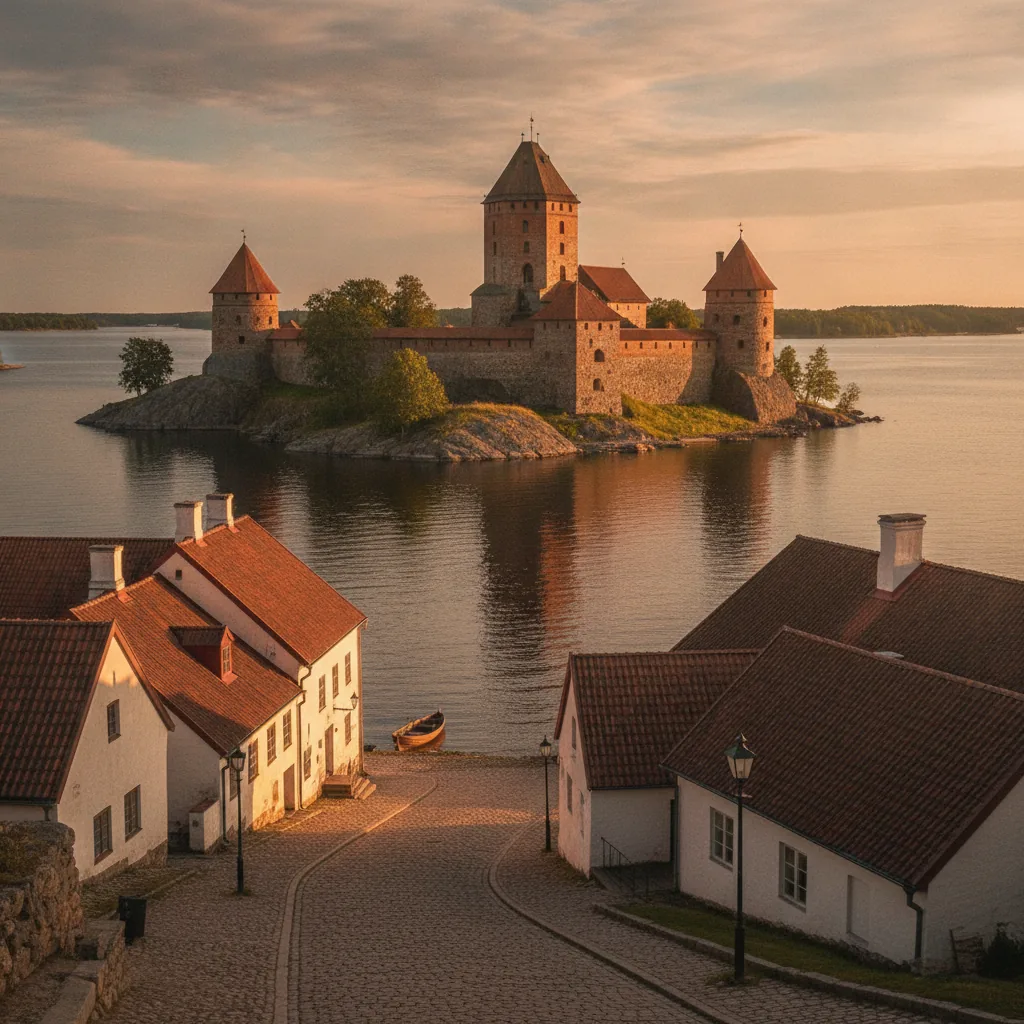
Vyborg, located 130 kilometers northwest of Saint Petersburg on the Karelian Isthmus near the Gulf of Finland, is the only preserved medieval town in Russia. Its cobbled streets, Swedish-built castle, and layered history spanning Swedish, Finnish, and Russian rule make it a unique day-trip destination from Saint Petersburg. The journey takes roughly 1.5 hours by train or 2 hours by car, and the town rewards visitors with a compact, walkable centre, a formidable 13th-century fortress, and a distinctive culinary tradition centred on the Vyborg pretzel. This article covers everything you need to plan your day: transport options, the castle in detail, walking routes through the old town, local food, and practical tips for a smooth visit.
Getting to Vyborg from Saint Petersburg
The most reliable and popular way to reach Vyborg is by the high-speed Lastochka train (ЭС1/ЭС2Г) operated by Russian Railways. Trains depart from Finlyandsky Station (Финляндский вокзал) in Saint Petersburg, located at 6 Lenina Square, a 10-minute walk from Ploshchad Lenina metro station on the Kirovsko-Vyborgskaya Line (red line). The journey takes approximately 1 hour 20 minutes to 1 hour 35 minutes, with trains running roughly every 1.5 to 2 hours throughout the day. The first departure is around 06:30 and the last return train from Vyborg leaves around 20:30. As of 2025, a one-way ticket costs between 350 and 600 RUB depending on class and advance purchase. Tickets can be bought at the station ticket office, at self-service kiosks, or via the RZD mobile app. It is advisable to book at least one day in advance during summer weekends and holiday periods, as trains fill up quickly.
Alternatively, a slower suburban elektrichka (electric train) also runs from Finlyandsky Station, taking about 2.5 hours and costing around 200 RUB one-way. These trains stop at many intermediate stations and are less comfortable, but they offer a budget option. For those driving, the route follows the M10/E18 highway (Scandinavia Highway) north-west from Saint Petersburg. The drive takes about 2 hours in normal traffic, but road conditions can be poor in winter. Parking in Vyborg is limited; the main paid parking lot is at Market Square (Rynochnaya Ploshchad), costing 50 RUB per hour. Buses also connect Saint Petersburg's Northern Bus Station (Severny Avtovokzal) to Vyborg, with a journey time of 2.5 to 3 hours and a fare of about 400 RUB. However, train is generally preferred for speed and punctuality.
For comprehensive advice on getting around Saint Petersburg itself, see our Complete Guide to Saint Petersburg. For details on the city's metro system, refer to our Metro Guide. Information on taxis to and from the station can be found in our Taxi Services article.
Vyborg Castle: History, Architecture, and Visiting
Vyborg Castle (Выборгский замок) is the town's undisputed centrepiece. Founded in 1293 by the Swedes during the Third Swedish Crusade under Marshal Torkel Knutsson, it was built on a small island in the Vyborg Bay to secure Swedish control over the Karelia region. For over 400 years, it served as the eastern outpost of the Kingdom of Sweden, withstanding numerous sieges by Novgorod and later Muscovy. The castle was captured by Peter the Great's forces in 1710 during the Great Northern War, after which it became part of the Russian Empire. It later passed to Finland in 1812 as part of the Grand Duchy of Finland, and then to the Soviet Union in 1944.
The castle's most prominent structure is the St. Olaf's Tower (башня Святого Олафа), a massive square keep that rises 48.6 meters above the island. Visitors can climb the 239 steps to the top for a panoramic view of the town, the bay, and the surrounding forest. The tower houses a small museum with exhibits on the castle's history, including medieval weaponry, archaeological finds, and models of the fortress as it appeared in different centuries. The admission fee to the castle is 400 RUB for adults (2025), with a reduced rate of 200 RUB for students and pensioners. The tower climb is included in the ticket. The castle is open daily from 10:00 to 18:00, except Mondays when it is closed. Last admission is at 17:00.
Beyond the tower, the castle grounds include a courtyard with a well, a commandant's house that now hosts temporary exhibitions, and a former arsenal building used for storage and workshops. The castle also has a small chapel dating from the 15th century, though it is not always open to the public. During summer, the castle hosts medieval festivals with jousting, archery, and crafts demonstrations, typically in August. These events attract large crowds, so plan accordingly.
For other major fortifications and palaces in the region, see our articles on Peterhof and Catherine Palace.
Practical Tips for the Castle Visit
- Wear comfortable shoes, the staircase in St. Olaf's Tower is narrow, steep, and uneven. The steps are worn stone, so grip is important.
- Arrive early, the castle gets busy by 11:00, especially from May to September. The first hour after opening is the quietest.
- Bring cash, the ticket office and small gift shop inside the castle often do not accept cards. ATMs are available in the town centre, but not on the island.
- Allow 1.5 to 2 hours for a thorough visit, including the tower climb and the museum exhibits.
- Check the weather, the tower top is exposed to wind, and rain can make the steps slippery. The castle is largely outdoors, so dress accordingly.
Walking the Medieval Town: A Self-Guided Route
After the castle, the best way to experience Vyborg is on foot. The old town, known as Gamla Stan (Old Town in Swedish), is a compact network of narrow, winding streets lined with 19th-century and earlier buildings. Many structures are in various states of disrepair, but restoration work has accelerated in recent years. A walkable route of about 2.5 kilometres takes 2 to 3 hours with stops.
Start at Market Square (Rynochnaya Ploshchad), the main square of the town. Here you will find the Vyborg Market Hall (Vyborgsky Kryty Rynok), an Art Nouveau building from 1905 designed by Finnish architect Karl Hård af Segerstad. The market sells local produce, meat, fish, and souvenirs. It is open daily from 08:00 to 18:00 (until 16:00 on Sundays). From the square, walk east along Krepostnaya Street (Крепостная улица), the main pedestrian thoroughfare. This street is lined with cafes, restaurants, and shops, and leads to the Vyborg Town Hall (built 1895, now housing the city administration).
Continue to Mon Repos Park (Парк Монрепо), a 161-hectare English-style landscape park established in the late 18th century by Baron Ludwig Heinrich von Nicolay. The park is located on the island of Tverdysh, connected to the mainland by a bridge. It features winding paths, rocky outcrops, a wooden Chinese pavilion, and the remains of a neo-Gothic chapel. Admission is 250 RUB for adults (2025). The park is open from 09:00 to 21:00 in summer, and until 18:00 in winter. Allow at least 1 hour for a stroll.
Returning to the town centre, walk along Leningradsky Prospekt (Ленинградский проспект) to see the Alvar Aalto Library (built 1933-1935), a masterpiece of Finnish functionalist architecture. The library was designed by the renowned architect Alvar Aalto and features his signature wave-shaped wooden ceiling in the lecture hall. It is open to the public during working hours (Monday to Friday 11:00-19:00, Saturday 11:00-17:00) and entry is free.
Finally, walk down Podgornaya Street (Подгорная улица), a steep, cobbled lane that runs from the castle hill down to the bay. This street is one of the most photographed in Vyborg, with views of the castle and the water. It ends at the Vyborg Embankment, where you can find a small beach and a pier for boat trips in summer.
For more walking routes in Saint Petersburg itself, see our Walking the Centre guide.
Vyborg Pretzel and Local Cuisine
No visit to Vyborg is complete without trying the Vyborg pretzel (выборгский крендель). This is a large, soft, sweet bread twist flavoured with cardamom, saffron, and sometimes almonds or raisins. Its history dates back to the 16th century when German bakers in the town created it. The pretzel became so famous that it was exported to Sweden and Finland. Today, it is sold at several bakeries and cafes in the old town. The most authentic version is available at Pirogi & Krendel (Пироги & Крендель) at 10 Krepostnaya Street, where a large pretzel costs 350 RUB. Another good option is Krendelnaya (Крендельная) at 4 Leningradsky Prospekt, which sells both sweet and savoury versions. The pretzel is best eaten warm, paired with coffee or tea.
Other local specialities include Karelian pasties (калитки), rye dough pies filled with rice, mashed potato, or millet, and Vyborg fish soup (уха по-выборгски), a creamy fish soup made with salmon, potatoes, and dill. For a sit-down meal, try Restaurant Esplanade (Ресторан Эспланада) at 8 Krepostnaya Street, which serves Russian and European dishes in a historic building. A three-course meal costs around 1,500-2,000 RUB per person. For a quick lunch, the Market Hall food court offers inexpensive local fare such as blini (pancakes) with sour cream for 150 RUB.
Practical Information for Day Trippers
Border Zone and Documentation
Vyborg lies within the border zone of the Russian Federation, only 30 kilometres from the Finnish border. Foreign visitors must carry their passport and migration card at all times. Russian visa regulations apply; ensure your visa is valid for the entire period of your stay. For up-to-date information on entry requirements, see our Entry Requirements article. Additionally, check our Government Travel Advisories for the latest security and travel warnings.
Currency and Payments
As of 2025, many shops, cafes, and attractions in Vyborg accept credit cards (Visa, Mastercard, MIR), but cash is still widely preferred, especially in smaller establishments and the market. ATMs are available at several banks in the town centre, including Sberbank at 1 Leningradsky Prospekt and VTB at 12 Krepostnaya Street. It is wise to carry at least 2,000 RUB in cash for the day. For a broader overview of payment practices in the region, refer to our Payment Realities article.
Opening Hours and Seasons
Vyborg is a year-round destination, but the best time to visit is from May to September when the weather is mild and all attractions are open. In winter, days are short (sunlight from 09:00 to 16:00 in December), and some outdoor areas, such as Mon Repos Park, can be icy. The castle remains open year-round, but the tower climb may be closed in severe weather. Most museums and shops are closed on Mondays. The White Nights period (June, July) offers extended daylight until 23:00, making it possible to enjoy the town until late evening. Learn more about this phenomenon in our White Nights article.
Accommodation (if staying overnight)
While Vyborg is perfectly doable as a day trip, some visitors prefer to stay overnight. Options include the Vyborg Hotel (Отель Выборг) at 2 Leningradsky Prospekt, a Soviet-era property with basic rooms starting at 2,500 RUB per night, and the more modern Druzhba Hotel (Гостиница Дружба) at 5 Zheleznodorozhnaya Street, with rooms from 3,500 RUB. For budget travellers, the Vyborg Hostel at 8 Krepostnaya Street offers dorm beds from 800 RUB. For recommendations in Saint Petersburg, see our Budget Hotels, Mid-Range Hotels, and Luxury Hotels guides.
Transport within Vyborg
The town centre is compact and walkable. If you arrive by train, the station is a 10-minute walk from Market Square. Local buses (routes 1, 2, 6, and 12) connect the station to the outskirts, but they are seldom needed. Taxis are available at the station and Market Square; a ride anywhere in the town centre costs around 150-250 RUB. For information on Saint Petersburg's bus and trolley network, see our Buses and Trolleys article.
Return Journey
The last Lastochka train from Vyborg to Saint Petersburg departs at approximately 20:35 (check the RZD app for exact times). The station has a small waiting room and a ticket office open until 21:00. If you miss the last train, a taxi to Saint Petersburg costs around 3,000-4,000 RUB and takes 2 hours. Alternatively, a bus from the Vyborg bus station (next to the train station) departs at 21:30 and arrives in Saint Petersburg around midnight, costing 500 RUB.
Suggested Day Trip Itinerary
- 08:30, Arrive at Finlyandsky Station, buy tickets, and board the 09:00 Lastochka.
- 10:30, Arrive in Vyborg. Walk to Market Square (10 min). Grab a coffee and a pretzel at Pirogi & Krendel.
- 11:00, Visit Vyborg Castle. Spend 1.5 hours exploring the tower and museum.
- 12:30, Walk through the old town along Krepostnaya Street, see the Town Hall and Alvar Aalto Library.
- 13:30, Lunch at Restaurant Esplanade or a quick bite at the Market Hall.
- 14:30, Stroll through Mon Repos Park (1 hour).
- 15:45, Walk down Podgornaya Street to the embankment. Take photos of the castle from the water.
- 16:30, Free time for shopping or a second pretzel. Visit the Vyborg Market Hall for souvenirs.
- 17:30, Walk back to the train station. Board the 18:00 or 20:35 Lastochka.
- 19:30 / 22:00, Arrive back at Finlyandsky Station, Saint Petersburg.
For information on drawbridges in Saint Petersburg that may affect your return if you are staying on Vasilyevsky Island or Petrograd Side, see our Bridge Schedule article. For advice on the best neighbourhoods to stay in Saint Petersburg, read our Best Areas guide.