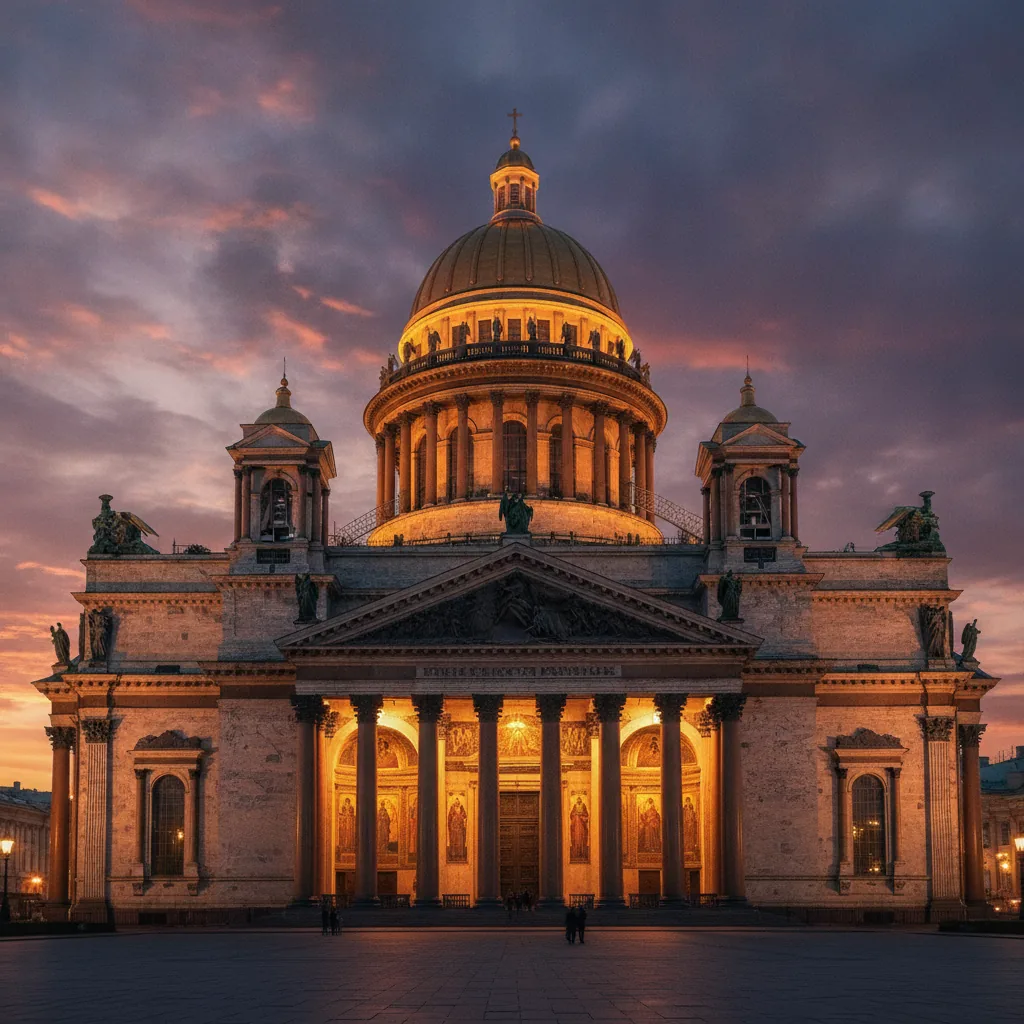
St. Isaac's Cathedral (Исаакиевский собор) is one of the largest and most iconic landmarks in Saint Petersburg. Its golden dome dominates the skyline, and its interior contains some of the finest examples of Russian monumental art and craftsmanship from the 19th century. For visitors, the cathedral offers two distinct experiences: the opulent, museum-like interior on the ground floor and the panoramic views from the colonnade that encircles the drum of the main dome. This article provides a comprehensive look at both, with practical details for planning your visit.
The cathedral stands on St. Isaac's Square, just a short walk from the Hermitage Museum and the Bronze Horseman. It is open year-round, though access to the colonnade is weather-dependent. The official address is St. Isaac's Square, 4, Saint Petersburg, 190000. The nearest metro stations are Admiralteyskaya (blue line) and Sennaya Ploshchad (purple line), each about a 10-15 minute walk.
History and Construction
The current building is the fourth church erected on this site. The first, a wooden church built in 1710 for workers of the Admiralty, was named after Isaac of Dalmatia, the patron saint of Peter the Great (who was born on his feast day). The second, a stone church, was begun in 1717 but proved structurally unsound. The third, designed by Antonio Rinaldi under Catherine the Great, was never completed in its intended form.
The present cathedral was built between 1818 and 1858, under the reign of Alexander I and then Nicholas I. The architect was Auguste de Montferrand, a French-born architect who had studied under Charles Percier and Pierre-François-Léonard Fontaine. Montferrand was personally chosen by Alexander I after submitting a design that won a competition. The construction took 40 years, employing 400,000 workers, many of whom were serfs. The total cost was 23 million silver roubles (an enormous sum at the time).
The cathedral was consecrated on 11 June 1858. During the Soviet era, it was used as an anti-religious museum from 1931 to 1937, then as a museum of the history of the cathedral. During the Siege of Leningrad (1941-1944), the golden dome was painted over to avoid serving as a target for German artillery, and the interior housed exhibits on the city's defence. In 1991, a decision was made to hold regular services again, though the cathedral still functions primarily as a state museum.
The Dome and the Colonnade
The dome is the third-largest domed cathedral in the world by diameter, after St. Peter's Basilica in Rome and St. Paul's Cathedral in London. The main dome has a diameter of 25.8 metres (85 feet). It is constructed of brick and covered in 100 kg of gold leaf, applied in the 19th century and restored in the 2000s. The dome rises to a height of 101.5 metres (333 feet) above ground level.
The colonnade (the circular walkway around the drum of the dome) is accessed via a spiral staircase of 262 steps. It is separate from the cathedral interior and has its own ticket office. The observation deck offers a 360-degree panorama of central Saint Petersburg. From here, you can clearly see the Admiralty spire, the Winter Palace, the Peter and Paul Fortress, the Neva River, and the many canals and bridges of the city centre.
Key details for visiting the colonnade:
- Opening hours: 10:30 to 18:00 (last entry 17:30) in winter; 10:00 to 22:30 (last entry 22:00) from 1 May to 31 October. Always check the official website before going, as hours change seasonally.
- Ticket price: Adults, 450 rubles (as of 2025). Reduced price for students and pensioners, 200 rubles. Photography is allowed without flash.
- No lift: only stairs. Not wheelchair accessible.
- The colonnade is often very busy in summer, with queues forming early. Arrive by 10:00 to avoid the longest wait.
- At the top, the walkway is about 3 metres wide, with a stone balustrade. It can feel crowded on peak days, but the views are unobstructed.
For a sunset visit, the colonnade often stays open until 22:30 in summer. This is the most popular time for photographers. The light on the Neva and the golden spire of the Admiralty creates unforgettable silhouettes. On a clear day, you can see as far as the Gulf of Finland and the Lakhta Centre skyscraper.
Practical Tips for the Colonnade
- Buy tickets at the kiosk to the left of the main entrance (facing the cathedral). You cannot buy colonnade tickets inside the cathedral itself.
- There is no elevator. The staircase is narrow and steep in places. If you are afraid of heights or have mobility issues, this may not be suitable.
- The upper walkway is exposed to wind and weather. In winter, the metal steps can be icy; wear non-slip shoes.
- There are no toilets at the top. Use the facilities near the ticket office before ascending.
- In summer, the sun is low until about 22:00, so a hat and water are advisable.
The Cathedral Interior
Entering the cathedral itself takes you into a vast, richly decorated space. The interior covers an area of 4,000 square metres, with a central dome that rises to a height of 80 metres above the floor. The iconostasis (a screen separating the nave from the sanctuary) is a massive structure made of malachite and lazurite, with gilded bronze columns. The malachite alone came from the Demidov mines in the Urals; about 16 tonnes of malachite were used.
Highlights of the interior include:
- The main iconostasis, 24 metres high, with three royal doors. The malachite columns are each about 10 metres tall.
- The mosaic work, the cathedral contains more than 300 mosaic icons and panels, covering an area of about 1,000 square metres. The mosaics were created by the Russian Academy of Arts and are considered some of the finest in the world. They were executed in the 19th century using the reverse technique (opus inversum).
- The stained-glass window of the Resurrection of Christ, located behind the main altar, it is 28.5 metres tall (the largest in Russia at the time of installation). It was created by the German firm Ainmiller & Retsch.
- The columns of lapis lazuli and malachite, six columns of lapis lazuli flank the central iconostasis, each weighing about 16 tonnes. They came from the Badakhshan mines in today's Afghanistan.
- The ceiling paintings, the dome interior is painted with a fresco of the Holy Spirit (by Karl Bryullov) surrounded by gold stars. The pendentives (the curves at the base of the dome) feature four Evangelists painted by Pyotr Basin and others.
- The marble and granite, the walls are faced with varieties of Russian and Italian marble. The floors are made of coloured marble and granite tiles, arranged in geometric patterns.
Visitors should note that photography without flash is permitted in most areas. However, during religious services (which are held in the alcove to the right of the main nave), photography is not allowed. Modest dress is requested: shoulders and knees should be covered, and men should remove hats.
Ticket Information for the Interior
- Opening hours: same as colonnade (10:30-18:00 winter; 10:00-22:30 summer). Last entry 30 minutes before closing.
- Ticket price: Adults, 500 rubles. Reduced price, 250 rubles. Audio guide available in English, French, German, Spanish, Italian, Chinese, and Russian for 200 rubles extra.
- Buy tickets at the ticket office inside the colonnade building (ground floor) or online at the official museum website (isas.spb.ru). Online booking is recommended in summer to avoid queues.
- Combined ticket for interior + colonnade: 650 rubles (adults). This saves 300 rubles compared to buying separately. Valid for one visit.
- Free entry: for children under 7, war veterans, and disabled visitors (with documentation). Free entry on the first Thursday of each month for all categories (limited periods).
The Square and Surroundings
St. Isaac's Square itself is a fine example of 19th-century urban planning. It is bounded by the Mariinsky Palace (now the Legislative Assembly of Saint Petersburg), the Hotel Astoria (built 1912), and the blue-domed Church of the Saviour on the Spilled Blood (though that is farther away). The square contains a paved pedestrian area with fountains and a monument to Nicholas I (completed in 1859, the first equestrian statue in Europe supported by only two points).
The cathedral's location also places it near the walking centre of the city, making it easy to combine with a visit to Nevsky Prospekt (about 5 minutes' walk north). Many taxi services and buses and trolleys stop along the square. The nearest bridge schedule (for the Palace Bridge and the Dvortsovy Bridge) can be checked at the river information points along the Neva embankment.
Restoration and Maintenance
St. Isaac's Cathedral has undergone several major restorations. The most recent began in 2005 and was largely completed by 2009 for the interior and 2012 for the dome. The restoration of the gilded dome required special scaffolding that covered the entire drum. The 100 kg of gold leaf was replaced using modern techniques to ensure longer life. The exterior stone walls (faced with Finnish granite) were cleaned of soot and pollution. The cost of the 2005-2012 restoration was estimated at 2.5 billion rubles, funded from the state budget and private donations.
Since 2017, the cathedral has been at the centre of a legal dispute about transfer from state to Russian Orthodox Church ownership. As of 2025, it remains a state museum under the Ministry of Culture, though weekly Orthodox services are held in a side chapel. The main nave continues to be a museum open to all.
Nearby Attractions and Itineraries
St. Isaac's Cathedral is often combined with a visit to the Hermitage (10 minutes' walk), or as part of a walk across the Dvortsovy Bridge to the Peterhof or the Catherine Palace in Pushkin (both further out, accessible by train or hydrofoil).
For a half-day itinerary: start at the cathedral at 10:00 (colonnade first, then interior). Walk past the Bronze Horseman along the Neva embankment (5 minutes). Continue to the Admiralty building (10 minutes), then to the Winter Palace side of Palace Square. This route avoids backtracking and covers three major landmarks. For lunch, the area around St. Isaac's Square has several mid-range cafes, including the official museum café in the ticket building (open 10:00-17:00).
Those interested in luxury hotels will find the Hotel Astoria (part of Rocco Forte) directly on the square. Mid-range hotels such as the Sokos Hotel Palace Bridge are within 500 metres. For budget hotels, the area around Sennaya Ploshchad has several hostels and inns. When planning your trip, always check government travel advisories for current entry requirements and payment realities (such as the use of local cards or cash).
Should You Visit Both Interior and Colonnade?
Given the separate admission fees, many visitors wonder whether either part is skippable. The answer depends on your interests:
- If you love panoramic views and clear sightlines over the city, the colonnade is essential. It offers a perspective that no other viewpoint in the centre provides (the Hermitage bell tower is lower, and the Spire of the Peter and Paul Fortress is not accessible to the public).
- If you are interested in religious art, mosaics, or 19th-century interior decoration, the interior is one of the richest in Europe. The malachite and lapis lazuli columns are unique in the world outside of the Hermitage.
- For most visitors, a combined ticket is the best value. You can spend 4 hours total (1-1.5 for the colonnade, 2.5-3 for the interior).
In any case, St. Isaac's Cathedral offers a deep look into St. Petersburg's imperial past, its architectural ambition, and its role as a cultural centre. Whether you are standing on the colonnade at sunset or gazing up at the mosaic of the Holy Spirit, the cathedral leaves a lasting impression.