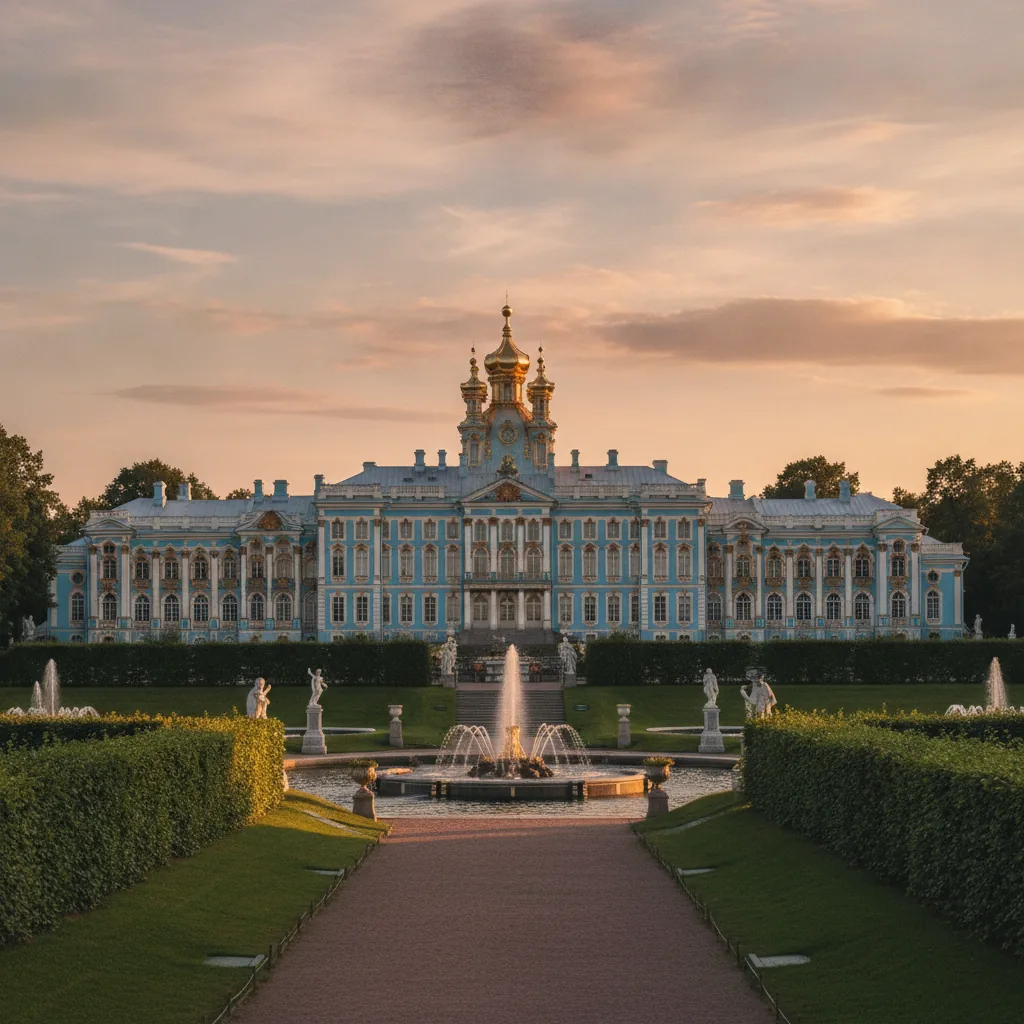
The Catherine Palace at Tsarskoye Selo, located about 25 kilometres south of central Saint Petersburg, stands as one of Russia’s most opulent imperial residences. Built for the empresses Catherine I and Elizabeth Petrovna, the palace is renowned for its striking blue-and-white facade, its gilded state rooms, and above all, the legendary Amber Room, a chamber entirely faced with panels of amber, gold leaf, and mirrors. The palace and its surrounding gardens form part of the Tsarskoye Selo museum complex, a UNESCO World Heritage Site that attracts over 3 million visitors annually. This article covers the palace’s history, the Amber Room’s dramatic story, the main interiors, the gardens, and practical advice for visiting, including tickets, opening hours, and how to get there from the city centre.
Understanding the palace requires a grasp of its origins. Originally a modest two-storey building constructed in 1717 for Catherine I (wife of Peter the Great), it was transformed into a grandiose Baroque palace by the architect Bartolomeo Rastrelli between 1752 and 1756 under Empress Elizabeth. Rastrelli’s design, the so-called “Russian Baroque”, features a 325-metre-long facade, richly ornamented with pilasters, pediments, and over 100 kilograms of gold leaf applied to the exterior stucco. The palace was the summer residence of the Romanovs until the 1917 revolution. During World War II, the palace was heavily damaged by Nazi occupation and subsequent fires. The post-war restoration, still ongoing in some sections, has painstakingly recreated the interiors based on pre-war photographs, drawings, and archival records. The reconstruction of the Amber Room was completed only in 2003.
History of the Catherine Palace
The site at Tsarskoye Selo (meaning “Tsar’s Village”) was originally a Swedish manor captured by Peter the Great in 1708. He gave the estate to his wife, the future Empress Catherine I, in 1710. The first stone palace was built between 1717 and 1723 by German architect Johann Braunstein. It was a relatively modest two-storey building with 16 rooms. After Catherine’s death in 1727, the palace passed to her daughter Elizabeth, who later ascended the throne in 1741. Elizabeth entertained in lavish style and ordered a complete reconstruction to rival the palaces of Versailles.
Bartolomeo Rastrelli, the chief architect of the Russian court from 1738, was tasked with expanding the palace. His plan was approved in 1752. The reconstruction added galleries, state rooms, a church, and the famous five gilded domes over the palace chapel. The work was completed in only four years, using thousands of serfs and soldiers. The cost was immense: 1.6 million rubles at the time, an enormous sum. Rastrelli also designed the adjoining Catherine Park and the Hermitage Pavilion. The palace is one of the finest examples of Elizabethan Baroque.
Later rulers, notably Catherine the Great (reigned 1762-1796), disliked the ornate Baroque style and had several rooms redecorated in Neoclassical style by the Scottish architect Charles Cameron. Cameron added the Chinese Blue Drawing Room, the Arabesque Hall, and the Cameron Gallery, a long colonnade attached to the palace. After Catherine’s death, the palace remained a summer residence for subsequent emperors, but it was rarely used after the 1830s. Regular maintenance and minor modifications continued until 1917. After the revolution, the palace was turned into a museum, opened to the public in 1918. The state rooms and private apartments were accessible.
During the German occupation of the town of Pushkin (as Tsarskoye Selo was renamed after the poet Alexander Pushkin in 1937), the palace was used as a barracks and a hospital. The Germans looted many artworks, including the original Amber Room panels, which were dismantled and shipped to Königsberg (modern Kaliningrad). In 1944, as the Red Army advanced, the palace was set on fire. The interior burned completely, and the exterior was heavily damaged. After the war, the Soviet government decided to restore the palace to its 18th-century appearance, a project that continues to this day. The grand ceremonial rooms, the Great Hall, the Grand Enfilade, and the Amber Room, were recreated using pre-war photographs and original fragments where possible. The Amber Room reconstruction, funded by German company Ruhrgas AG, cost $7 million and was completed in 2003 for the 300th anniversary of Saint Petersburg.
The Amber Room
The Amber Room is the single most famous feature of the Catherine Palace, and arguably of any palace in Russia. Its story is one of creation, loss, and meticulous reconstruction. The original Amber Room was a Baroque chamber decorated with amber panels, gold leaf, and mirrors. It was designed by German sculptor Andreas Schlüter and Danish amber craftsman Gottfried Wolfram. The panels were originally created for King Frederick I of Prussia in 1701. In 1716, Frederick’s son, King Frederick William I, presented the amber panels to Peter the Great as a diplomatic gift, sealing an alliance between Prussia and Russia. The panels arrived in Saint Petersburg in 20 large crates and were initially installed in the Winter Palace. Empress Elizabeth later had them moved to the Catherine Palace in 1755. Rastrelli gave the Amber Room its final design, adding extra panels, gold leaf, and Florentine mosaics. The room contained more than 6 tonnes of amber, arranged in intricate geometric patterns, with mirrored pilasters and a gilded wood surround.
The room was about 55 square metres in area, and the panels were set on a gold background. It was considered the “Eighth Wonder of the World” by many contemporaries. The room was used as a private study and reception room for the empress. During the 18th and 19th centuries, it was carefully maintained, although amber, a fossilised resin, is fragile and prone to darkening and cracking. In 1941, when the German army invaded the Soviet Union, the curators of the Catherine Palace tried to dismantle the Amber Room for safe storage. But the panels were too brittle; they began to crumble. So the curators covered them with wallpaper in a desperate attempt to hide them. The Germans, however, discovered the deception, removed the panels, and shipped them to Königsberg Castle. There, they were re-installed and exhibited until 1944. In August 1944, the Royal Castle in Königsberg was heavily bombed by the Royal Air Force. The Amber Room was reportedly destroyed in the fire. Many of its fragments have been found in the decades since: a Florentine mosaic from the room was recovered in Bremen in 1997, and some original carved drawers and a cabinet turned up in various German cities. But the majority of the room is presumed lost forever.
The reconstruction of the Amber Room was authorised by the Soviet government in 1979. The work began in 1983, using pre-war black-and-white photographs, colour slides, and archival documents. Artisans used original techniques and materials, including Kaliningrad amber (the region produces 90% of the world’s amber), as well as gold leaf and Florentine mosaics. The project employed a team of 50 specialists. It took over 20 years and cost $7 million, provided by the German company Ruhrgas AG. The reconstructed room was unveiled in June 2003 at the celebration of Saint Petersburg’s 300th anniversary. Today, the Amber Room is the most visited part of the Catherine Palace, with up to 4,000 people passing through it on a busy day. Visitors are not allowed to touch the panels or use flash photography. The room is dimly lit to protect the amber, but the effect is spectacular: golden light reflects off the panels, creating a warm, glowing atmosphere.
The Amber Room in numbers
- Original amber panels: 6 tonnes (approx.)
- Reconstruction cost: $7 million (funded by Ruhrgas AG)
- Years of reconstruction: 1983-2003 (20 years)
- Number of specialists involved: 50
- Area of the room: 55 m²
- Daily visitors (peak): up to 4,000
The Palace Interiors
Beyond the Amber Room, the Catherine Palace contains around 40 reconstructed rooms, though only about 20 are open to the public. Visitors follow a fixed route starting from the main staircase, through the Great Hall, the Grand Enfilade of state rooms, the Amber Room, and then several private apartments and the picture gallery. The route ends at the palace church.
The Great Hall (The Light Gallery)
The Great Hall, or the Light Gallery, is the largest room in the palace, measuring 860 square metres. It was designed by Rastrelli for imperial audiences, balls, and banquets. The hall is double-height, with huge windows on both sides that flood the room with light. The gilded carving in Baroque style covers almost every surface: mirrors, pilasters, caryatids, and floral garlands. The ceiling painting, “The Triumph of Russia” by Italian artist Giuseppe Valeriani, depicts an allegorical scene of Russia’s military and cultural victories. The original painting was destroyed in the war; the current version was recreated in the 1950s. The floor is an inlaid parquet of rare woods, oak, walnut, and mahogany. The Great Hall holds up to 1,000 guests. During the imperial era, it was used for court ceremonies, such as the “Great Dress Ball” held annually on the empress’s birthday. Today, occasional concerts take place here; tickets cost around 1,500-3,000 RUB.
The Grand Enfilade
A sequence of seven state rooms stretches along the palace’s second floor, known as the Grand Enfilade. They are connected by doorways aligned so that a visitor can see through all seven when they stand at one end. The rooms include the Portrait Hall, the Cavaliers’ Dining Room, the State Dining Room, the Picture Hall, and the Arabesque Hall. Each room has its own colour scheme and decorative theme. The Picture Hall, for instance, holds over 100 paintings from the 17th and 18th centuries, including works by Italian and Dutch masters. The Arabesque Hall, redesigned by Charles Cameron for Catherine the Great, contains delicate stucco panels in arabesque patterns, inspired by Roman frescoes discovered at Pompeii. The White State Dining Room is used for official dinners; its walls are covered in white silk with gold trim. The furniture in these rooms is mostly original, having been evacuated before the German invasion. Replicas of 18th-century chairs, tables, and chandeliers have been produced for rooms where originals were lost.
The Church of the Resurrection
Attached to the palace is the palace church, with five golden onion domes, an integral part of the palace silhouette. The church interior was originally decorated with gilded iconostasis and frescoes. It was severely damaged in the war but has been restored. The church is included on the visitor route. The icons are mostly 18th-century copies. Services are held on major feast days only.
The Gardens of Tsarskoye Selo
The Catherine Palace is set within two extensive parks: the formal Catherine Park (also called the Regular Park) and the landscape Alexander Park. Together, they cover over 300 hectares. The parks are open to the public and are popular for walking, picnicking, and boating in summer. Entrance to the parks is separate from the palace.
The Catherine Park (Regular Park)
The Catherine Park, directly adjacent to the palace, was laid out in a formal French-style geometric pattern in the early 18th century. It covers about 110 hectares. The central axis is a long, straight lime-tree avenue leading from the palace to the far end of a formal pond. The park contains numerous pavilions, bridges, and sculptures. Notable structures include:
- The Hermitage Pavilion, a two-storey Baroque building designed by Rastrelli in 1754, used for private dining. Its table could be hoisted mechanically from the ground floor to the first floor, allowing the royal family to dine without servants present. It is open to the public in summer (entry 200 RUB).
- The Grotto Pavilion, a grotto built by Rastrelli in 1756, decorated with shells and tuff stone. It was used as a cool retreat on hot days.
- The Upper Bath Pavilion, a small building with a sauna and plunge pool, used by Catherine the Great. It contains marble baths and stucco decoration. Open May, October (entry 150 RUB).
- The Cold Bath (also called the Cameleon Fountain), a bath complex with a cascade fountain. Restored in the 2000s.
- The Cameron Gallery, a long colonnade attached to the palace, built by Charles Cameron in 1785. It offers a view over the park. The gallery contains a statue of Catherine the Great, and it was a favourite spot for the empress to take her morning walks.
The park also features a large pond, called the Big Pond, with a small island where the Grotto of the Cupid (a small pavilion) stands. Rowboats are available for hire (400 RUB per hour in summer). The park is open from 7:00 AM to 11:00 PM daily in summer (May, October) and from 9:00 AM to 8:00 PM in winter. Entry to the Catherine Park is 150 RUB for adults (2024), free for children under 16. It is best to visit in late May or early June when the lilacs and tulips are in bloom.
The Alexander Park
To the east of the palace lies the Alexander Park, a landscape park of 200 hectares, created in the 18th and 19th centuries in the English style, with winding paths, meadows, and artificial lakes. The park contains the Alexander Palace, the neoclassical residence of Emperor Nicholas II and his family, which is separate from the Catherine Palace. The Alexander Palace is currently undergoing massive restoration (it reopened partially in 2021). The park is less crowded than the Catherine Park and is free to enter. Key features include the Chinese Village (a row of 18th-century Chinese-style houses), the White Tower (a Gothic folly used by Nicholas II’s children), and the Ratmin’s Gate. The park is open daily until 10 PM.
Practical visitor information
Visiting the Catherine Palace and its gardens requires planning, as queues can be long, especially in July and August. The museum complex is located in the town of Pushkin (formerly Tsarskoye Selo), about 25 km south of Saint Petersburg. Here is what you need to know.
Getting there
The most common way to reach Pushkin from Saint Petersburg is by train from the Vitebsky Railway Station (at Pushkinskaya metro station). Electric trains (elektrichka) run roughly every 30-60 minutes. The journey takes about 30 minutes to Tsarskoye Selo station. From the train station, it is a 20-minute walk (or a short bus ride on routes 371, 382, or 378) to the palace. A taxi from the city centre takes about 45 minutes and costs 800-1,200 RUB (2024). Many guided tours include transport. Alternatively, you can take bus route 187 from Kupchino metro station or route 545 from Moskovskaya metro station. For more on getting around, see our metro guide and taxi services pages.
Tickets and opening hours
The palace is open from Tuesday to Sunday, 10:00 AM to 6:00 PM (last entry at 5:00 PM). Closed on Mondays and the last Wednesday of every month. The palace is closed on 1 January and 9 May (Victory Day). Tickets to the palace must be purchased with a timed entry slot. It is essential to buy tickets online in advance during peak season (May, September), as they often sell out days ahead. The official website (tickets.tsarselo.ru) sells tickets for the palace only (not the parks). In 2024, a full-price adult ticket costs 1,000 RUB for foreign visitors; reduced tickets (500 RUB) are available for students and Russian citizens. Entry to the Amber Room is included in the palace ticket. The parks have separate tickets (150 RUB for Catherine Park, free for Alexander Park). Audio guides are available in English (300 RUB).
What to bring and what to expect
Visitors must leave large bags and backpacks in the cloakroom (free). Photography is allowed without flash in most rooms (except the Amber Room where flash is prohibited; video recording requires a permit). The palace has no café inside; the nearest place to eat is at the Prince Pushkin Hotel or the Tsarskoye Selo restaurant near the Catherine Park entrance. There are also kiosks selling snacks and drinks. Toilet facilities are near the entrance. If you have mobility issues, be aware that the palace has no elevators for public use; there are many stairs. The park paths are paved and suitable for wheelchairs. For tips on staying in the area, see our best areas and budget hotels articles.
Guided tours
Many visitors opt for a guided tour from Saint Petersburg, which includes round-trip transport, entrance fees, and a guide. Prices start from about 3,500 RUB per person for a group tour (2024). Private tours cost 8,000-15,000 RUB. The advantage is that the group often bypasses the ticket queue (though you still queue for entry to the Amber Room). If you go independently, consider arriving by 9:30 AM to be among the first to enter the park. The palace entry time is strict; late arrivals may not be allowed in. For comprehensive planning, read our complete guide to Saint Petersburg.
The Amber Room’s legacy and impact
The Amber Room’s story has captivated the world. It has inspired books, films, and documentaries. The mystery of the missing original panels continues to intrigue treasure hunters and historians. In 2018, a study by German researchers suggested that some panels may have survived the bombing: they were hidden in bunkers or shipped out of Königsberg before the fire. A few small fragments, a carved monarch, a piece of stone, have been discovered in private collections in Germany and the UK. However, the vast majority appears to be lost. The reconstructed Amber Room, while not original, is a remarkable achievement of craftsmanship. It uses over 6 tonnes of amber from the Kaliningrad region, and its golden glow is a major draw for visitors to Saint Petersburg. In recognition of its cultural significance, the Russian government has declared the Amber Room a “particularly valuable object of cultural heritage” and has strict security measures in place. The room is constantly monitored for temperature and humidity to preserve the amber. In 2023, the museum installed new LED lights that reduce heat and UV damage. The room is insured for $500 million.
The Catherine Palace and the Amber Room are, without doubt, among the top sights in Saint Petersburg. Their combination of imperial grandeur, tragic history, and painstaking restoration offers an unparalleled glimpse into Russia’s past. For visitors, the palace is a must-see, but it demands time and advance planning. The experience, walking through the gilded halls, standing in the Amber Room, and strolling in the vast parks, is unforgettable. For more on the city’s other magnificent palaces, see our article on Peterhof and the Hermitage.
Final tips for a smooth visit
- Book tickets online at least 2 weeks in advance for summer.
- Arrive early (by 9 AM) to enjoy the park before the crowds.
- Wear comfortable walking shoes, the park is large.
- Bring water and snacks; the cafe is crowded and expensive.
- Combine your visit with the Alexander Palace if you have time.
- Check the bridge schedule if you are driving to ensure you don’t get caught by drawbridge openings in Saint Petersburg, see our bridge schedule.