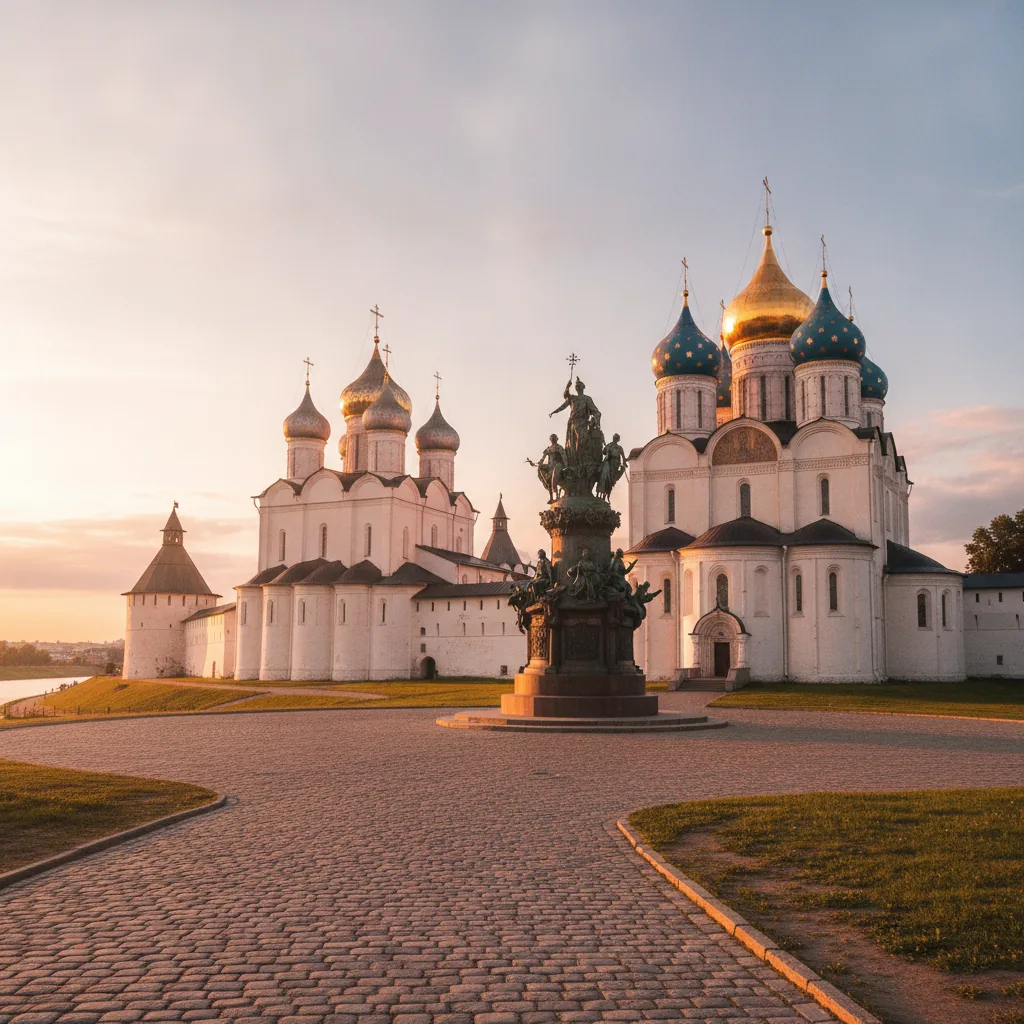
Getting from Saint Petersburg to Veliky Novgorod
The most efficient way to reach Novgorod is by high-speed train Lastochka from Moskovsky Vokzal (Moscow Railway Station) on the Saint Petersburg, Moscow line. The journey takes about 2 hours and 40 minutes, with departures roughly every two hours between 06:30 and 19:00. As of 2025, a one-way ticket costs 1,200-1,800 RUB in second class, depending on the time of booking and demand. Tickets can be purchased online via the Russian Railways website or at the station ticket office. The train arrives at Novgorod-on-Volkhov station, about 2 km east of the Kremlin. From there, a 25-minute walk or a short bus ride (routes 7, 11, or 18, fare 30 RUB) takes you to the city centre.
Alternatively, buses from Saint Petersburg’s Obvodny Canal Bus Station run frequently (every 40-60 minutes) and take around 3.5 hours. The fare is roughly 700-900 RUB one-way. Buses drop you at the Novgorod Bus Station, a 15-minute walk south of the Kremlin. For drivers, the M10 federal highway connects the two cities, the drive takes about 2.5 hours under normal traffic, though sections near Chudovo and Spasskaya Polist can be congested on weekends.
If you are basing your trip in Saint Petersburg, consult our complete guide to Saint Petersburg for accommodation and transport options before venturing out. For those arriving by air, our flight routes article covers connections to Pulkovo Airport, and the metro guide explains how to reach Moskovsky Vokzal from anywhere in the city.
The Novgorod Detinets: Russia’s Oldest Kremlin
The Novgorod Detinets, often called the Novgorod Kremlin, is the oldest surviving fortress in Russia. First mentioned in the chronicles under 1044, its current red-brick walls and towers date largely from the late 15th century, when Ivan III expanded and reinforced them after the city’s annexation by Moscow. The fortress occupies about 12 hectares on the left bank of the Volkhov River, shaped roughly like an irregular oval. Nine of the original twelve towers remain; the most famous are the Kokuy Tower (31.5 m high, climbable for 150 RUB) and the Palace Tower, which houses the main entrance.
Inside the Detinets, the centrepiece is the St. Sophia Cathedral, built between 1045 and 1050 by Prince Vladimir Yaroslavich, son of Yaroslav the Wise. This five-domed limestone cathedral is the oldest standing church in Russia proper (excluding Crimea). Its interior preserves fragments of 11th- and 12th-century frescoes, though most were whitewashed in the 18th century and later re-exposed during restorations. The cathedral’s iconostasis dates from the 15th, 16th centuries. You can also see the wooden “Korsun” doors (also called the Magdeburg Gates), cast in bronze in the 12th century in Magdeburg, Germany, and brought to Novgorod as war booty in the 14th century. Entry to the cathedral is 300 RUB for adults; photography inside requires an additional permit (150 RUB).
Adjoining the cathedral is the bell tower of St. Sophia, rebuilt in the 17th century after a fire. You can climb it for a panoramic view of the Volkhov River and the surrounding city, the ticket costs 200 RUB. The bells themselves are a modern reproduction; the original grand bell, cast in 1659, is displayed inside the cathedral museum.
The Millennium of Russia Monument
In the centre of the Kremlin’s main square stands the Millennium of Russia Monument, unveiled in 1862 to celebrate 1,000 years of the Russian state (traditionally dated from the calling of the Varangian prince Rurik in 862). The monument was designed by sculptor Mikhail Mikeshin and architect Victor Hartmann. It is a 16-metre-tall bell-shaped structure cast in bronze, weighing about 65 tonnes. The composition is arranged in three tiers: at the top, an angel holding a cross represents Orthodox Christianity; the middle tier contains six figures symbolising key periods of Russian history (including Rurik, the baptism of Prince Vladimir, the Battle of Kulikovo, the foundation of the Romanov dynasty, Peter the Great, and Catherine II); the lower tier features 109 historical figures, including rulers, clergy, military commanders, writers, and scientists, among them Alexander Pushkin, Mikhail Lomonosov, and Field Marshal Kutuzov.
During World War II, German forces occupied Novgorod from August 1941 to January 1944. The monument was dismantled by the occupiers and shipped to Germany, but after the war it was recovered and re-erected in its original location in 1945. The restoration work was completed by 1950. The monument is free to view; access to the surrounding lawn is unfenced.
Churches Beyond the Kremlin: Peryn Monastery and the Cathedral of the Nativity of the Mother of God
Novgorod is famous for its cluster of medieval churches, many built in the 12th, 15th centuries. A short walk south of the Kremlin, across the Volkhov River via the pedestrian bridge, lies the Peryn Monastery, founded in the 12th century at the site of a former pagan sanctuary to the god Perun. The monastery’s small stone Church of the Nativity of the Mother of God (built around 1230) is one of the smallest and oldest surviving churches in Russia, just 7.5 by 11.5 metres, with a single dome and a cruciform plan. It is open to visitors, but hours are limited (usually 10:00-17:00, closed Mondays). Entry is 100 RUB.
Further south, about 2 km from the Kremlin, is the Cathedral of the Nativity of the Mother of God within the Yuriev Monastery, one of the oldest monastic foundations in Russia, dating to 1030. The cathedral, built between 1119 and 1130, is larger than St. Sophia and features three domes and a massive narthex. Its interior retains fragments of frescoes from the 12th century, including a depiction of St. George slaying a dragon. The monastery grounds also contain the 17th-century Saviour’s Church and a bell tower. Entry to the cathedral is 200 RUB; guided tours in English are available on request for 500 RUB per person for groups of 5-10.
For a deeper understanding of the architectural evolution, consider our article on St. Isaac’s Cathedral for contrast with later imperial-era churches, or the Catherine Palace guide for the baroque exuberance that overtook Russian ecclesiastical architecture in the 18th century.
The Novgorod State United Museum (Kremlin Museums)
Within the Detinets, several museum buildings house collections spanning archaeology, icon painting, and applied arts. The Museum of the History of Novgorod (located in the former Bishop’s Palace, sometimes called the Faceted Palace) covers the city’s political and cultural history from the 9th to the 17th centuries. It displays the original Charter of Prince Vsevolod Mstislavich (12th century) and birch-bark manuscripts, the famous berestyanaya gramota that documents everyday life in medieval Novgorod. Over 1,200 such texts have been discovered, the earliest dating to the 11th century. The museum offers a 45-minute English-language audio guide (300 RUB). Entry is 400 RUB for adults.
The Icon Museum, housed in the Church of St. Simon (also in the Kremlin), exhibits a selection of 13th, 17th century Novgorodian icons, including a rare panel of the “Saviour on the Throne” (late 13th century) and the “Military Church” icon (15th century). Combined tickets covering the Kremlin museums cost 700 RUB and are valid for two days.
If you are planning multiple visits to heritage sites in the region, read our guide on Saint Petersburg attractions, the Hermitage alone can consume a full day, so balance your itinerary accordingly. For those travelling from abroad, our entry requirements page covers visa and passport rules, and the payment realities article explains how to carry cash and use cards in Russia (contactless payments are widely accepted in Novgorod).
Practical Tips for a Day Trip
Timing: Aim for the 06:30 or 08:30 train from Saint Petersburg. This puts you in Novgorod by about 10:00-11:00, giving you 6-7 hours before the last return train around 20:00. If you want more time, consider the 20:30 train, which arrives back in Saint Petersburg around 23:15, but check the evening train schedule in advance, as it changes seasonally.
Food: Inside the Kremlin, the Detinets Café serves pelmeni, blini, and soup for 250-400 RUB per dish. Outside the Kremlin, on Sennaya Square, the restaurant Zavalinka (12 Sennaya Square) offers traditional Novgorodian cuisine, try the ushkui (small fried pies with mushrooms or meat) for 200 RUB. For a quick lunch, the Bistro near the Kremlin on Bolshaya Moskovskaya Street has pizza and salads for 300-400 RUB.
Cash: Reliable ATMs are located at the Kremlin entrance and inside the bus station. Most shops and restaurants accept cards (Mastercard and Visa, though American Express is less common). Our payment realities article provides more detail on card usage.
What to bring: Comfortable walking shoes, you will cover at least 8 km within the Kremlin and surrounding churches. A bottle of water is advisable, as free public drinking fountains are rare. In summer (June, August), temperatures range 18-25°C; in shoulder seasons (May, September), bring a light jacket. The Kremlin grounds are open 24/7, but church and museum hours are generally 10:00-18:00, with some closed on Mondays.
Private tours: Several Saint Petersburg agencies offer guided day trips to Novgorod by minibus, costing 4,500-7,000 RUB per person including lunch and entrance fees. Booking at least three days in advance is recommended, especially during the White Nights season (late May, July) when demand peaks.
If you need accommodation in Saint Petersburg before or after the trip, our guides for budget hotels, mid-range hotels, and luxury hotels can help you find suitable lodging. For moving around the city, the walking centre article suggests routes, and the taxi services article explains ride-hailing apps like Yandex.Taxi.
Historical Context: Why Novgorod Matters
Novgorod, meaning “new town”, was founded in the 9th century and became the seat of Rurik and his Varangian retinue. By the 11th century, it was the economic and political centre of the Novgorod Republic, a medieval state that controlled a vast territory extending to the White Sea, the Arctic Ocean, the Urals, and the Baltic. The city was a key member of the Hanseatic League and traded fur, wax, honey, and timber with German, Danish, and Swedish merchants. The republic’s governance was unique: the veche (popular assembly) elected the prince, the archbishop, and the mayor (posadnik). This system lasted until 1478, when Ivan III conquered the city and annexed it to Moscow.
Architecturally, Novgorod’s churches represent the first distinctively Russian style, the so-called Novgorodian school, characterised by austerity, asymmetry, and a stepped silhouette (zakomary). Unlike the Byzantine-cross plan common in Kiev and later Moscow, Novgorodian builders used local limestone and employed a pliable mortar that allowed for more organic forms. This is evident in the Church of the Saviour on Nereditsa (1198), located 1.5 km south of the Kremlin, which was severely damaged in World War II but rebuilt in the 1950s. Its frescoes, preserved in fragments, are among the most important surviving examples of pre-Mongol Russian painting.
The city suffered heavy damage during the Nazi occupation, about 80% of its medieval structures were either destroyed or severely damaged. Post-war restoration, directed by architects such as Victor G. Ginzburg (no relation to the writer), aimed not only to reconstruct but also to stabilise the remaining foundations. The result is that many churches are open to the public, but some (like the Church of the Transfiguration on Ilyin Street, 1378) are undergoing ongoing conservation and are sometimes closed to visitors. Always check opening hours on the Novgorod Museum website before visiting.
For those interested in the broader context of Russian imperial and revolutionary history, our articles on the Hermitage and Peterhof illustrate the later development of Russian architecture and state power. The bridge schedule article may be useful if your Saint Petersburg visit involves crossing the Neva drawbridges during the navigation season.